
AI-powered briefings
The layer that sits above all the modules and tells me which of them I should care about.


Most of what I've written about RafeOS so far is modules. Each is useful on its own, but I wanted something that offered a summary and a cross-cutting opinion, and let me play around with the AI-powered synthesis.
Daily briefing
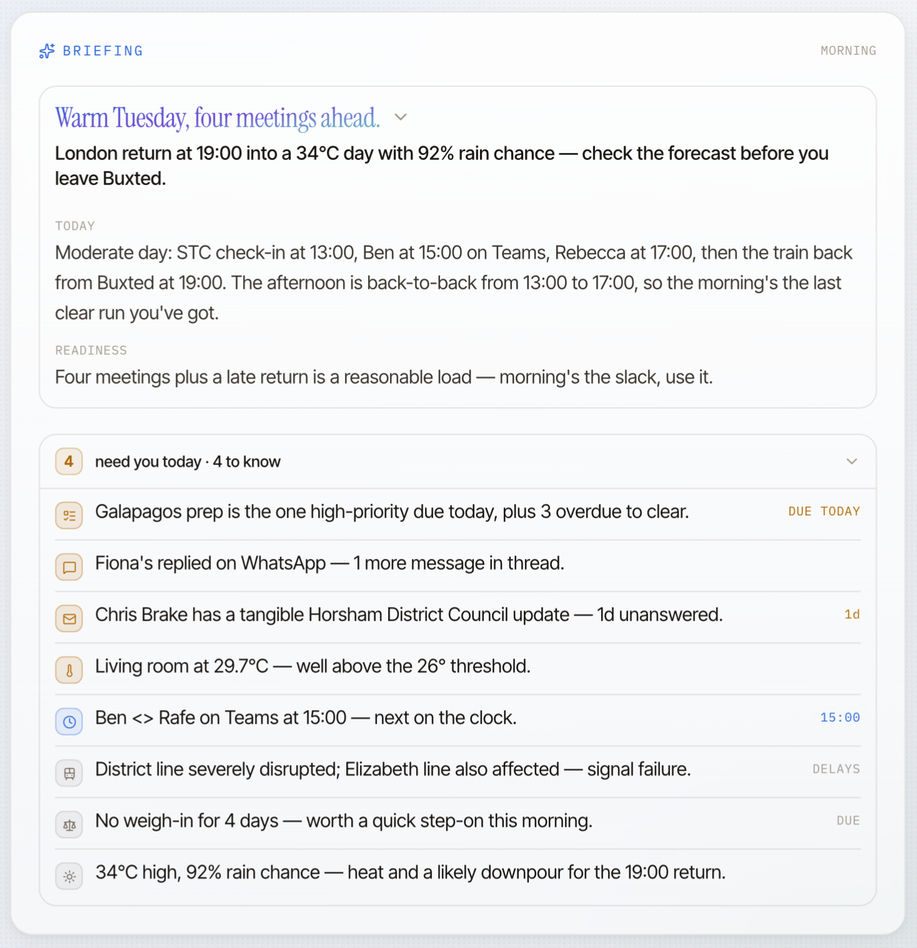
The briefing was the answer to that. It's the layer that reads everything else and brings me the handful of things that matter. I get sent it once a day via messaging, it's always present in Cockpit, and I can request it from the CLI too.
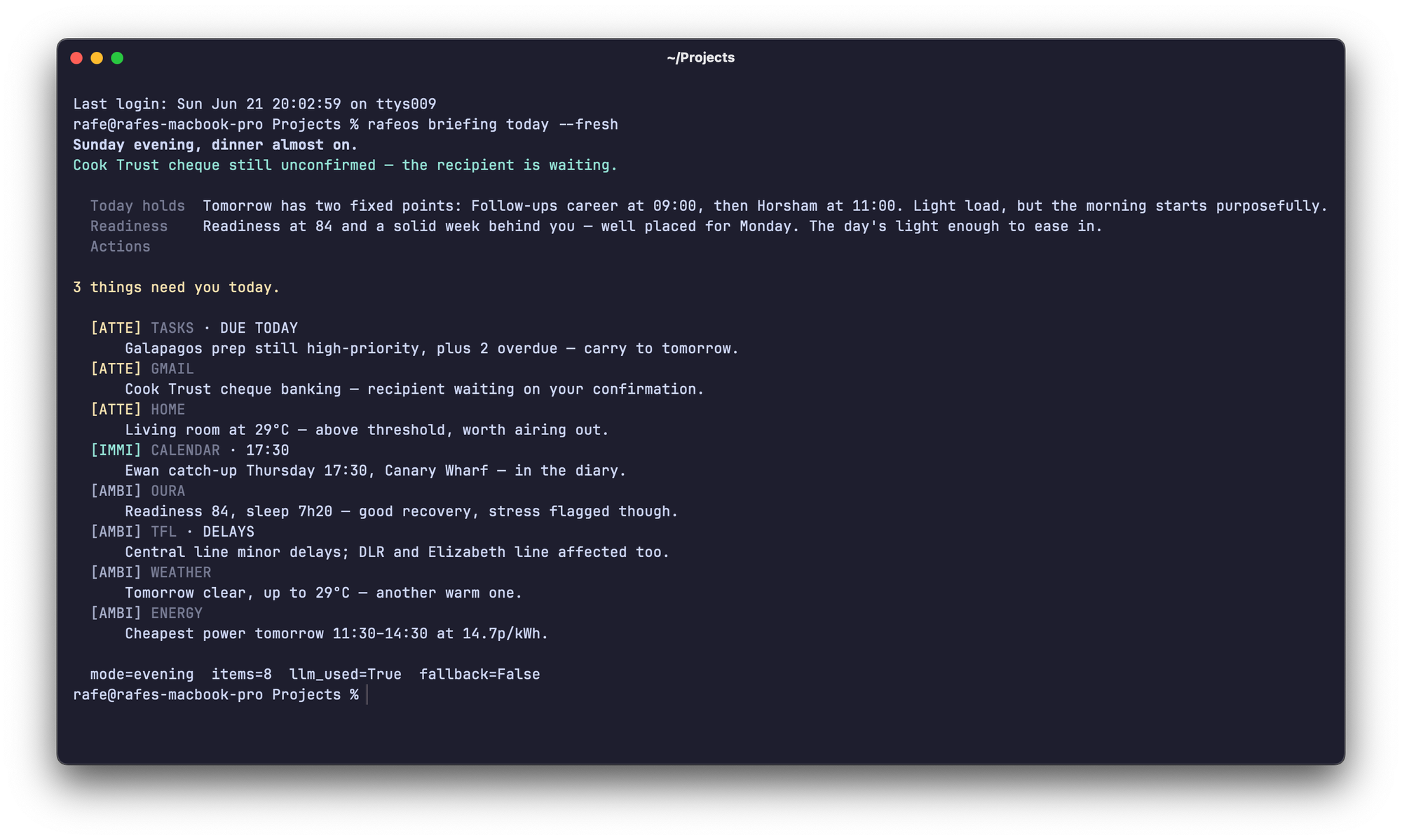
rafeos briefing today.The AI bit, and what it's trying to do
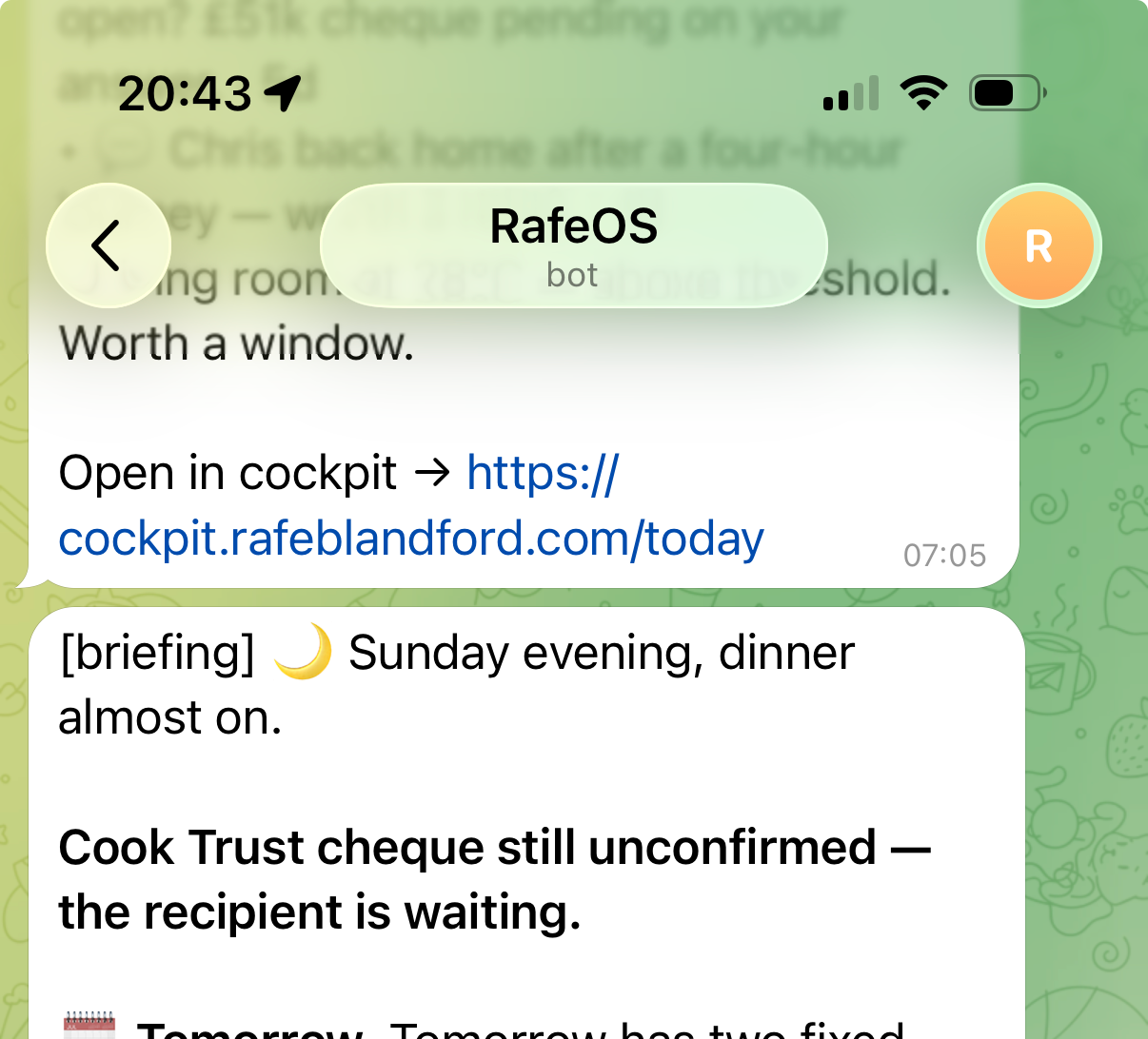
The daily briefing is short. A few lines of what's happening, what's needed, and what's moving. The first part is an AI-powered summary (probabilistic) that regenerates four to six times through the day and focuses on decisions. The second part is rules-powered (deterministic) that regenerates in real time and focuses on awareness. Both read from a lot of the system at once: calendar, tasks, messaging, weather, transport, health and so on.
The AI-powered daily briefing is a well-established pattern, but everyone has a different version. I want the briefing to make a decision and tell me the answer. Not "there's rain forecast and you have a meeting in town"; rather "take a jacket, leave fifteen minutes early, the line you'd normally use has delays".
It doesn't always land that cleanly. The prompt that generates the prose is something I'm still tuning. Sometimes it over-explains, sometimes it hedges, sometimes it tells me three things when one would do. Getting a model to be decisive without being recklessly confident is harder than it sounds. But the direction is right.
The rules-based bit
At the bottom of every briefing sits a short, fixed-shape status block: roughly the four things to do today and the four things to know. It's assembled by ordinary code from tools already in place, pulling the top tasks, the messages awaiting a reply, the calendar's next commitments, anything flagged as out of the ordinary. Each item is a deep link straight into the right RafeOS module, so if I want the detail on one of them I'm one tap away.
It's a good example of knowing when not to use AI. That said, it works, and can be somewhat opinionated, because the modules underneath are doing classification and inference using AI.
The added benefit is a briefing that degrades gracefully. Even if the model half of it is having an off day, or I've broken the prompt while tuning it, the bottom block is still correct, still useful, still there. I see this as right tool for the right job, but it's probably also a personal reaction against AI-ing everything.
The weekly health briefing
The daily briefing is a glance, but it's necessarily relatively shallow. I wanted to explore what AI might be able to do in a longer and more reflective format, something meant to be sat with rather than skimmed.
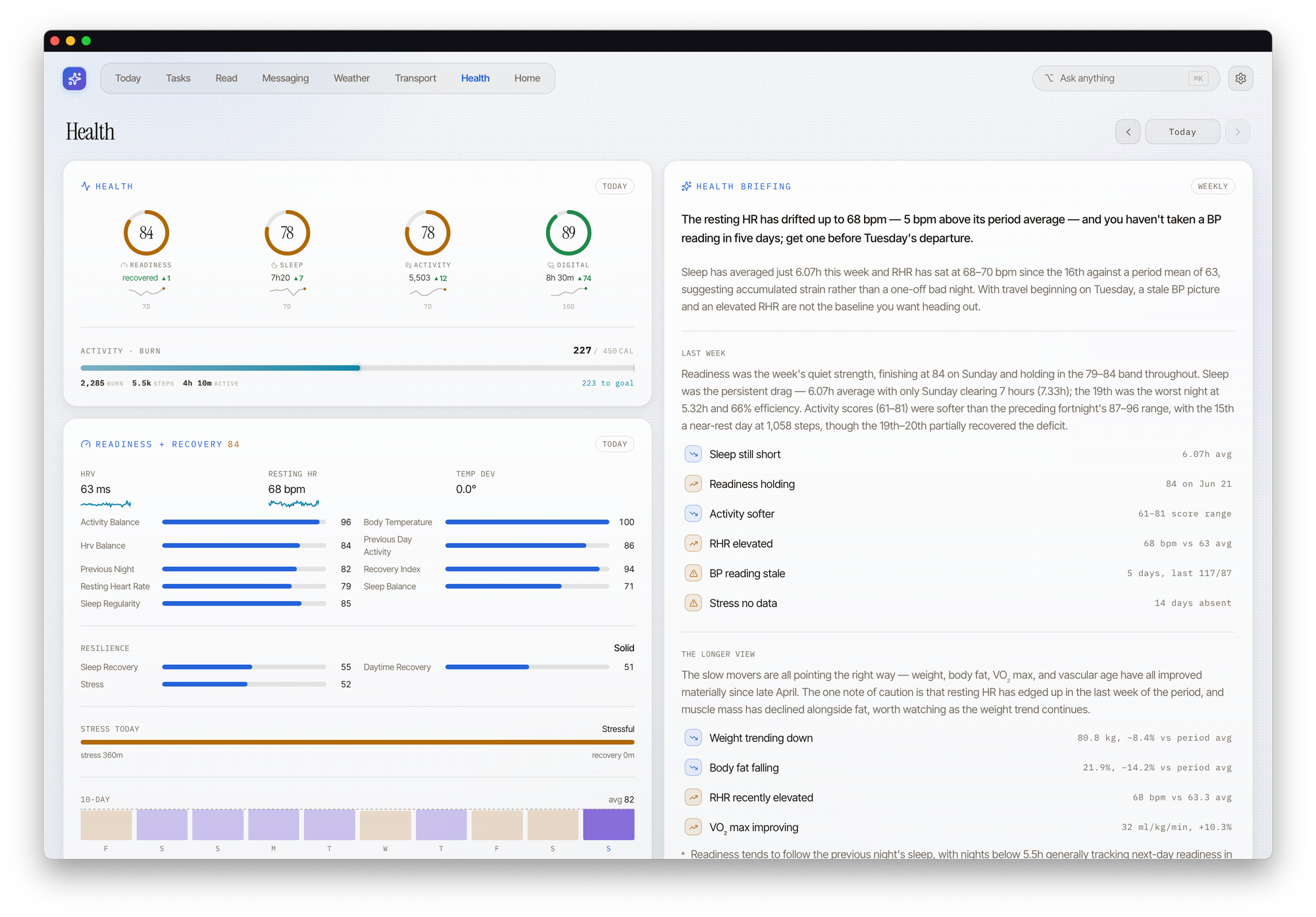
The weekly health briefing is effectively a cached reply to a set of questions I haven't asked yet.
Like the daily briefing, the shape is fairly fixed: an overall summary, then last week with its short-term trends, then the longer view across one to three months (is VO2 max creeping up, where's the body-mass line going), then correlated factors where it tries to join things up across the different health sources. It deliberately finishes on a single nudge. One thing to try this week. For example, a recent one noticed I've been doom-scrolling far too late into the evening and suggested a hard screen-off at half nine.
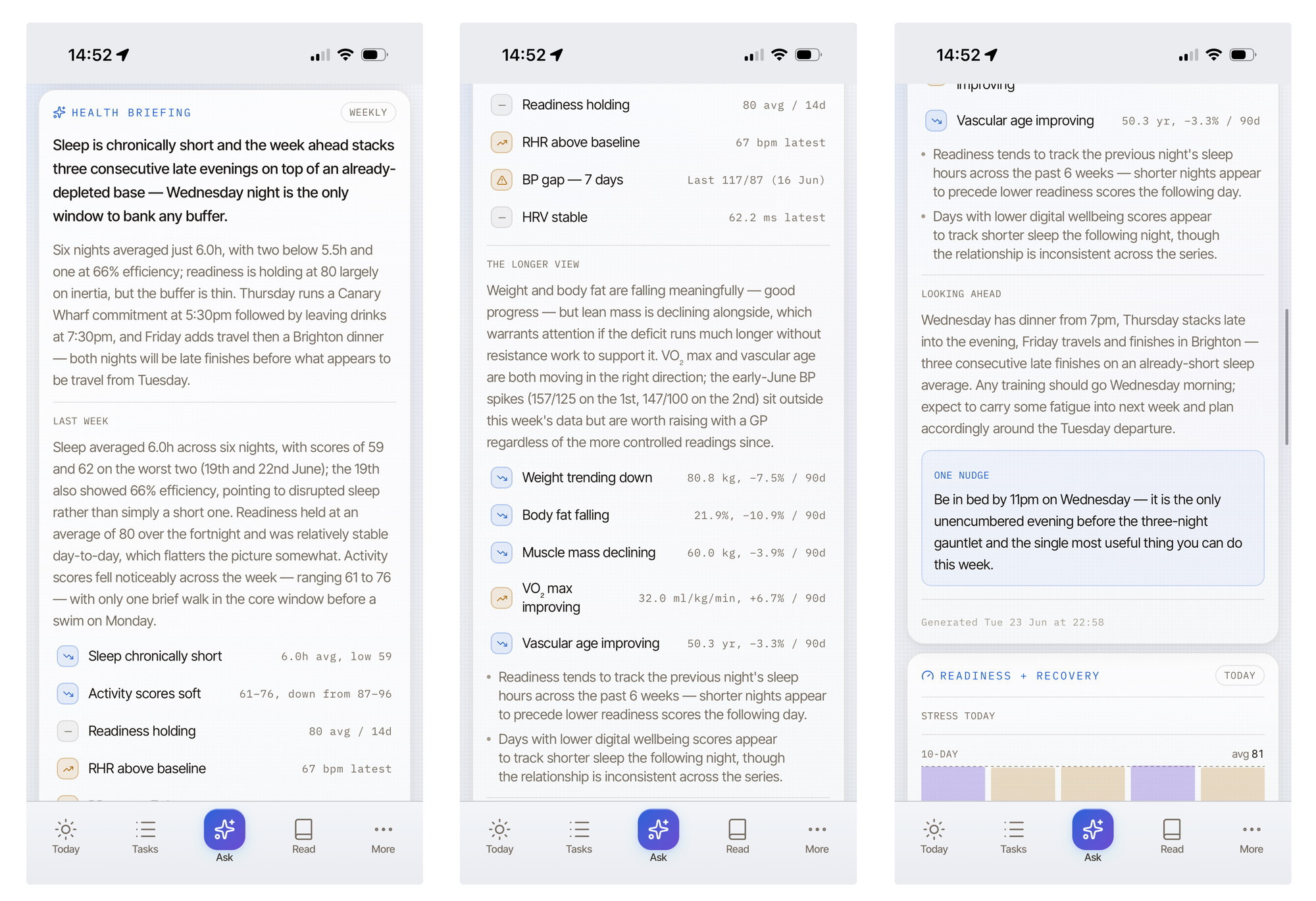
It's entirely AI-generated off a single prompt, which describes the desired format, has multiple instructions, and includes the "raw" health data. The primary source is RafeOS' unified health data, but it does use some of the other modules too for wider context (e.g. looking ahead using the calendar). Because there's more reasoning involved it currently uses Sonnet (contrasting with use of Haiku elsewhere).
The thing that makes it feel smooth to use is that it's already there when I want it. Asking a model to look across that much health data and reason about it properly takes a real moment, up to 30 seconds. So it's generated in the background once a week, which also keeps costs reasonable.
Keeping it honest
A lot of what the daily briefing tells me is, frankly, common sense. Take a jacket. You slept badly the week you were drinking more. Dressed up as a personalised intelligence brief, common sense can start to feel grander than it is, and I've pulled it back since the earlier versions (living with it, you soon work out what's useful and what's not).
I've been quietly fascinated by the health briefing. I like the weekly format... a deliberate slow down in daily quantified self obsession, but I'm also aware of the limitations here and I would draw a distinction between health measurement and health actions.
But the defence for both daily and health briefings is that presentation and timing matter too. I feel like I'm getting relevant information, plus some useful synthesis... and it does shape in-the-moment decisions and provides useful nudges. What it doesn't do, yet, is shape things much beyond that.
If you want the wider argument for why the meta-layer beats the modules, it's described more thoroughly and runs through what RafeOS is and why I'm building it.
On how this was made: the briefing is part of RafeOS, which is built collaboratively with AI; this post was also drafted with Claude and edited by me.
New writing by email
Occasional pieces on product, technology and AI — and how they actually play out in practice.


