
Making product ideas visible before they look finished
I built an agent skill to shorten the loop between talking, visualising and revising, while keeping product judgement where it belongs.

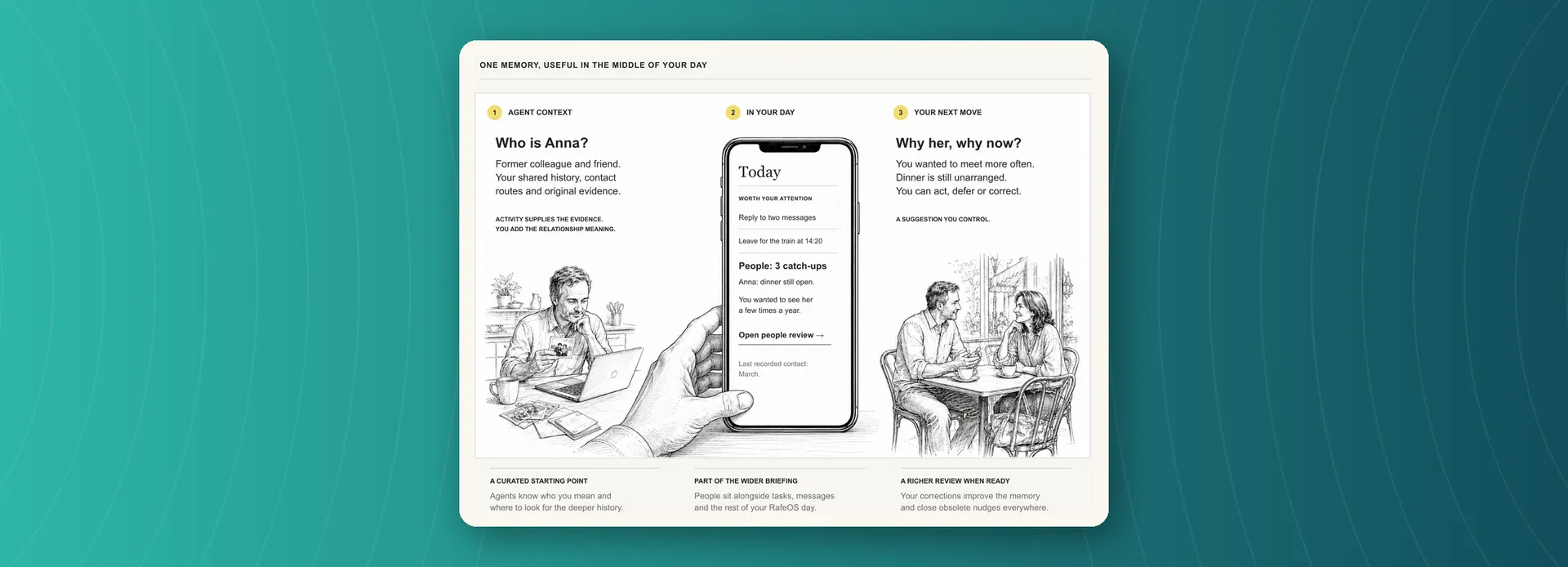
I've built something new. Product Idea Pack is an open Agent Skill that turns a rough thought, a brief or a substantial conversation into visual artefacts people can inspect, share and disagree with.
Working inside your favourite AI assistant, it can create a proposition sketch, a mechanism board, a product storyboard or an interactive prototype. Give it more context and it can produce several of them as a coherent pack, then hand the work over as editable files, a PDF, a PowerPoint deck or a Figma file.
The pictures are useful, but bringing forward the point at which an idea can be challenged matters more. I wanted to find out whether AI could remove some of the friction in early product discovery without removing the judgement and healthy disagreement that make discovery valuable in the first place.
The awkward middle
A product idea can spend a surprisingly long time trapped in someone's head, a set of workshop notes or a whiteboard photograph. Even when everyone feels aligned, there's always a danger that early on people are imagining different things.
The other failure mode is almost the opposite. Under time or cost pressure, the idea moves directly into polished interface design or development. Decisions that were provisional begin to look settled because the artefact looks finished. The team starts discussing the colour of a button before it has agreed what problem the button is meant to solve.
I've seen both patterns repeatedly, particularly in agency and professional-services environments. A workshop generates momentum, then the output takes two or three days to assemble and circulate. By the time stakeholders see it, some of that momentum has gone.
This matters more as production gets cheaper. If agents can turn an idea into working software rapidly, the bottleneck moves upstream. Deciding what is worth making, whose problem it solves, what has to be true and how you will know becomes more important, not less.
Product discovery has always been partly about defining the product and partly about alignment and influence. A visual artefact helps because it gives a group something specific to react to. It can travel beyond a workshop to people who could not be there and it acts as a lever for useful feedback. The best outcome is making the thinking clear enough that disagreement improves the idea.
Four formats, four different questions
Product Idea Pack's approach borrows from familiar practice: divergent and convergent thinking in the Double Diamond, design thinking's attention to people and possibility, and product thinking's insistence on viability, feasibility and strategic choice. The generated boards and canvases will look recognisable to anyone who has spent time in early product discovery or service design.
There are four core formats because they do different jobs:
- A proposition sketch makes a high-level idea understandable in seconds. Its job is to create interest and make the concept discussable, not to explain every detail.
- A mechanism board starts to expose how the idea works. It is very deliberately lighter than a service blueprint, but still shows whether there is a plausible mechanism underneath the proposition.
- A product storyboard explains an experience through moments. Narrative is useful because people understand products through what happens: what somebody sees, feels, decides and does next.
- An interactive prototype lets someone experience enough behaviour to understand the idea. The intention here is to widen understanding, not start execution.
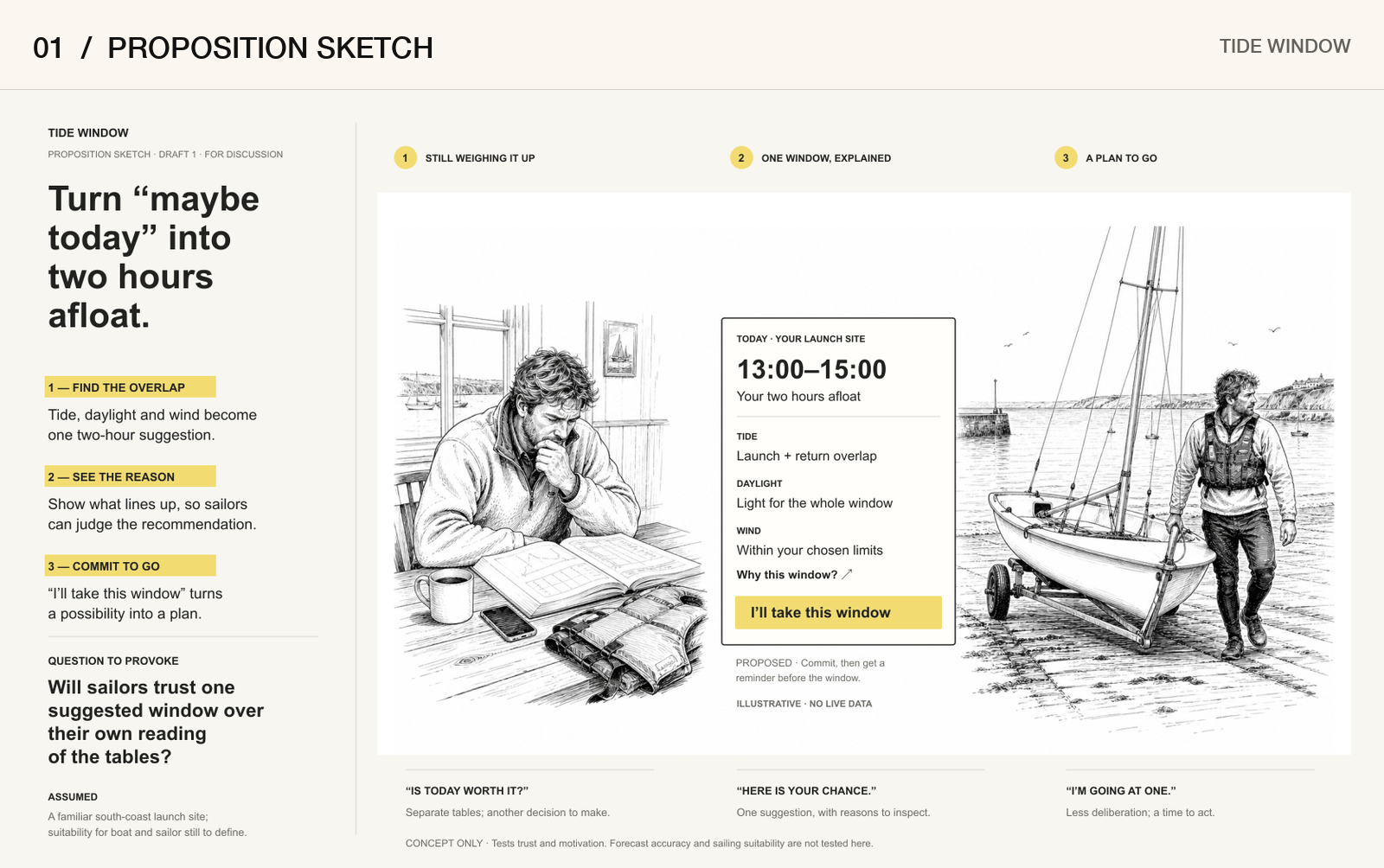
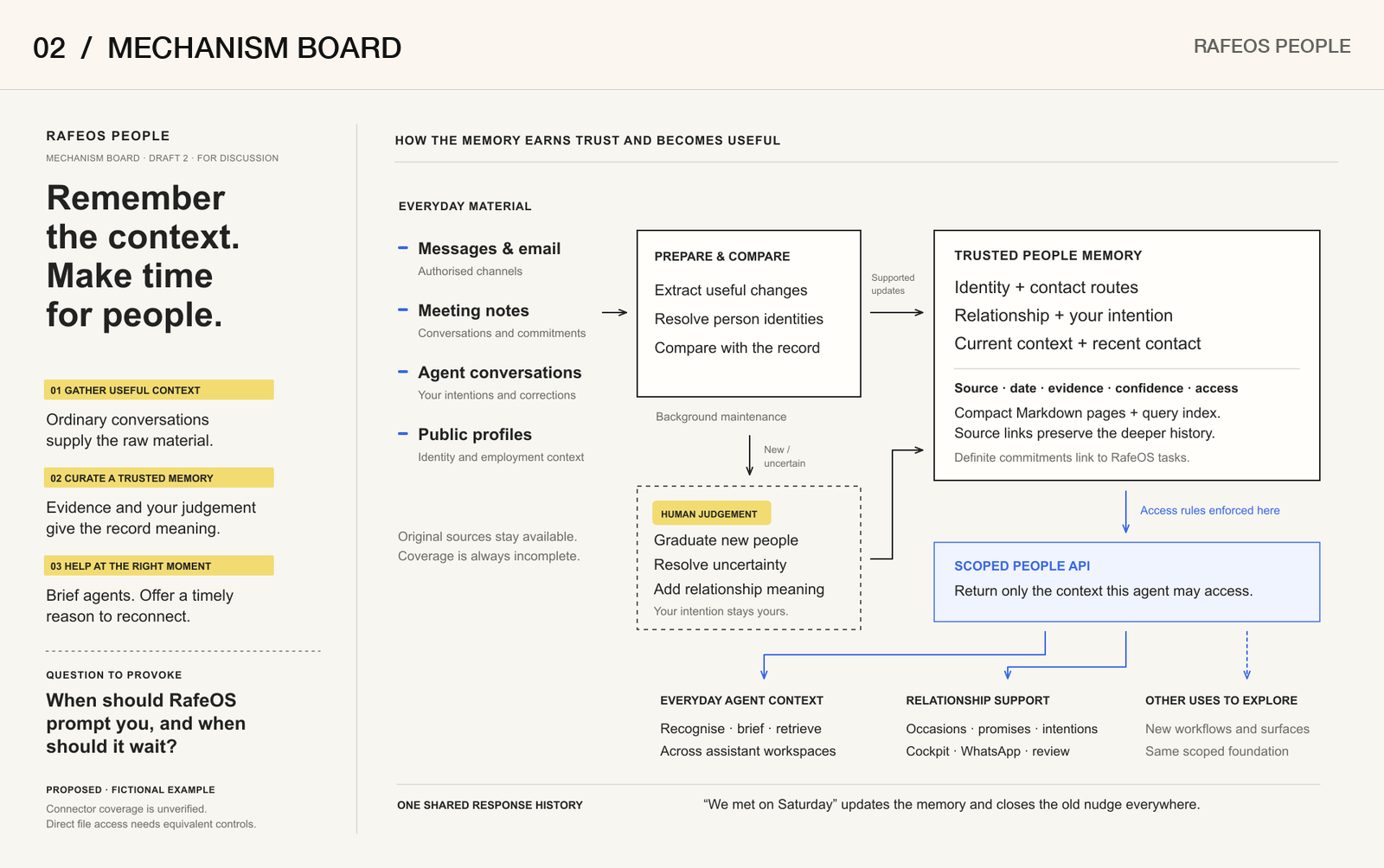
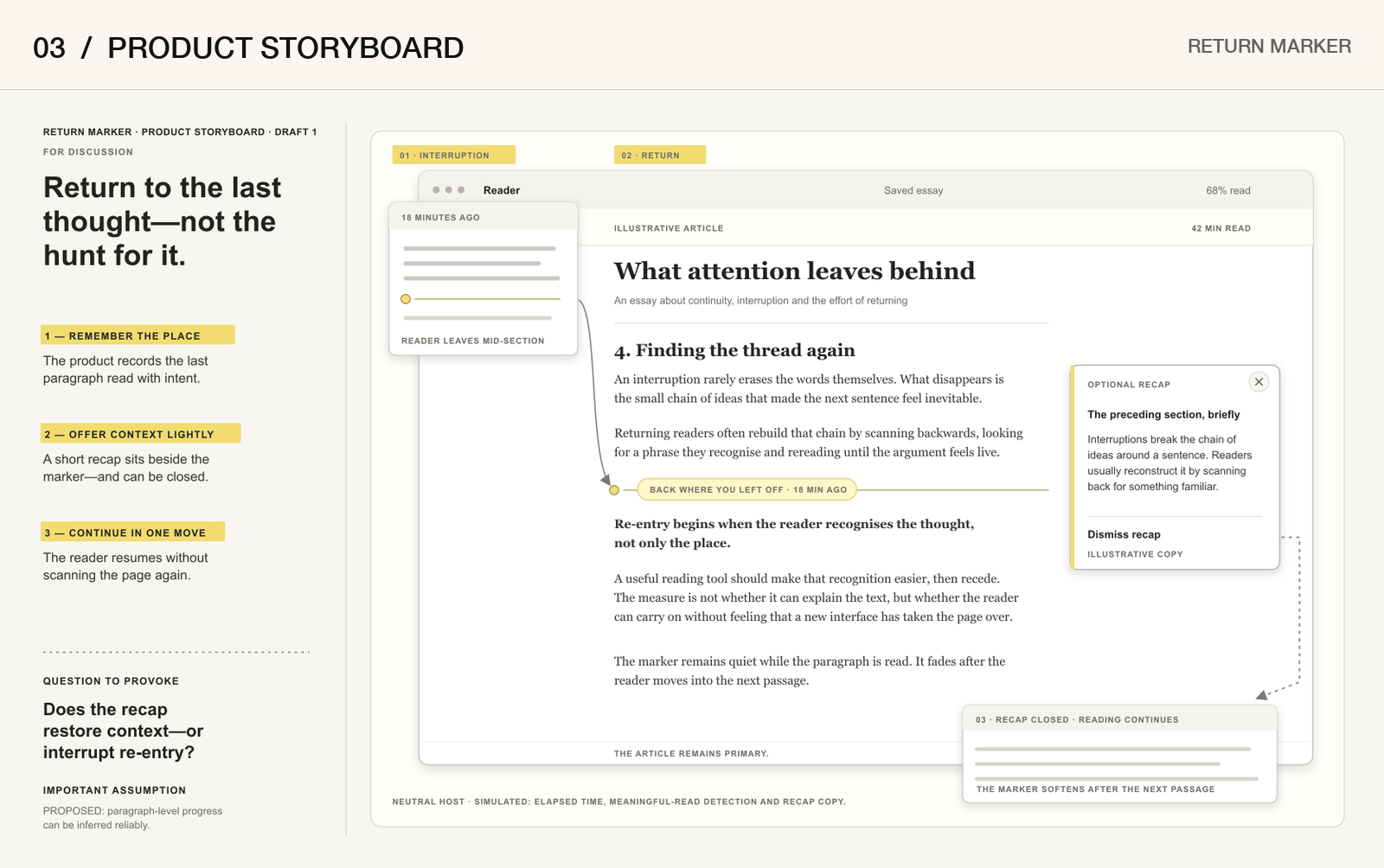
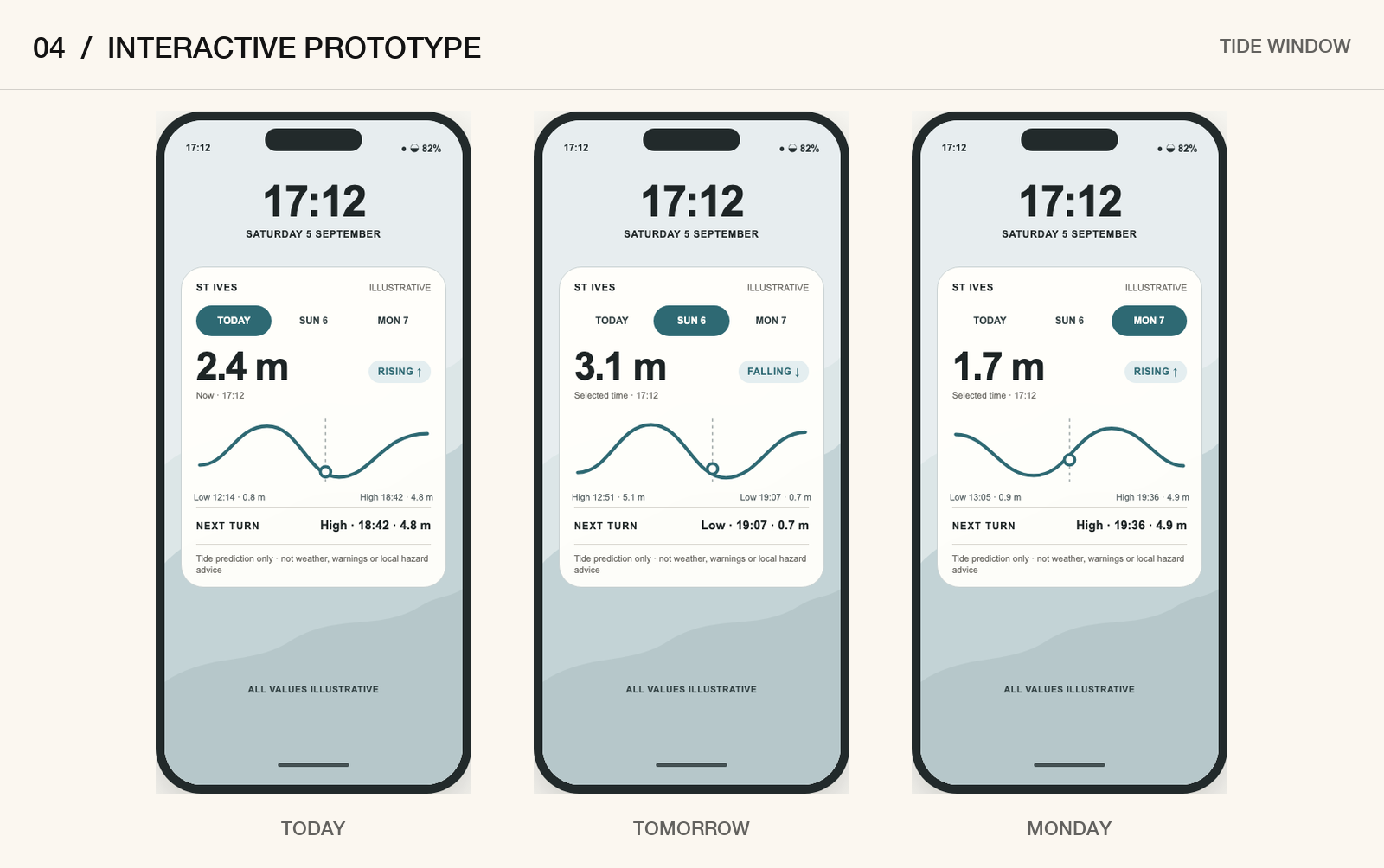
The four core formats: proposition sketch, mechanism board, product storyboard and interactive prototype.
These formats often represent increasing commitment, but they are not a compulsory pipeline. Sometimes a proposition sketch is exactly enough. Sometimes the uncertainty sits in the mechanism. Sometimes the quickest way to make sense of an interaction is to let someone use it.
All four deliberately retain signs of incompleteness because, in my experience, an artefact that looks provisional encourages discussion and change.
What AI makes cheaper
There are parts of this work that AI is particularly good at. In early testing, models were good at assembling material quickly, synthesising a wide-ranging conversation, creating a first visual representation and maintaining a common structure across multiple boards. They were also very good at drawing on familiar interface conventions (e.g. WhatsApp messaging) where novelty would add little.
The more important content still has to come from somewhere. What is the unmet need? Which tension matters? What is the riskiest assumption? What is distinctive about this idea rather than the average version a probabilistic model is likely to produce?
In my testing, a short prompt could produce a plausible first pass. A longer conversation, useful references and a clear learning question produced much stronger work. That is true of working with AI in general, but it is unusually visible here because weak thinking becomes a weak picture. It also underlines the absolute need for product sense and human judgement.
The hardest part to encode was the boundary between inference and intervention. Ask a person to approve every step and the workflow loses much of its speed. Give the model complete freedom and it may make the most important product decision by accident. Product Idea Pack therefore contains two connected systems: guidance for making the artefacts, and routing and quality checks for deciding what to make, when to ask and what to inspect before delivery.
I suspect that boundary is the part I will keep adjusting as other people use it.
RafeOS People made it real
One of the strongest tests began as an idea for RafeOS that had been percolating at the back of my mind. I had tried various contact-management and CRM tools. At the same time, I was experimenting with automatically assembled knowledge about the things I read, and wondering whether some of that model could apply to people.
There was a practical need underneath it. When talking to an agent, I would sometimes have to explain who somebody was or explicitly tell it where to search across email and messages. I also wanted to be more deliberate about keeping in touch with people, following up on things I had said I would do and not allowing relationships to drift simply because everyday life intervened.
The risk was obvious: it could become a sprawling CRM that demanded constant manual upkeep. I wanted something that felt more like useful memory and timely attention.
I talked the idea through at some length before invoking Product Idea Pack. That conversation supplied the idea kernel, constraints, personal motivation, and references that a short feature brief would have missed. The first output was promising, but it needed a substantial human correction and then a smaller tidy-up. The final result was five connected product boards plus a cover, a PDF and an editable Figma hand-off.
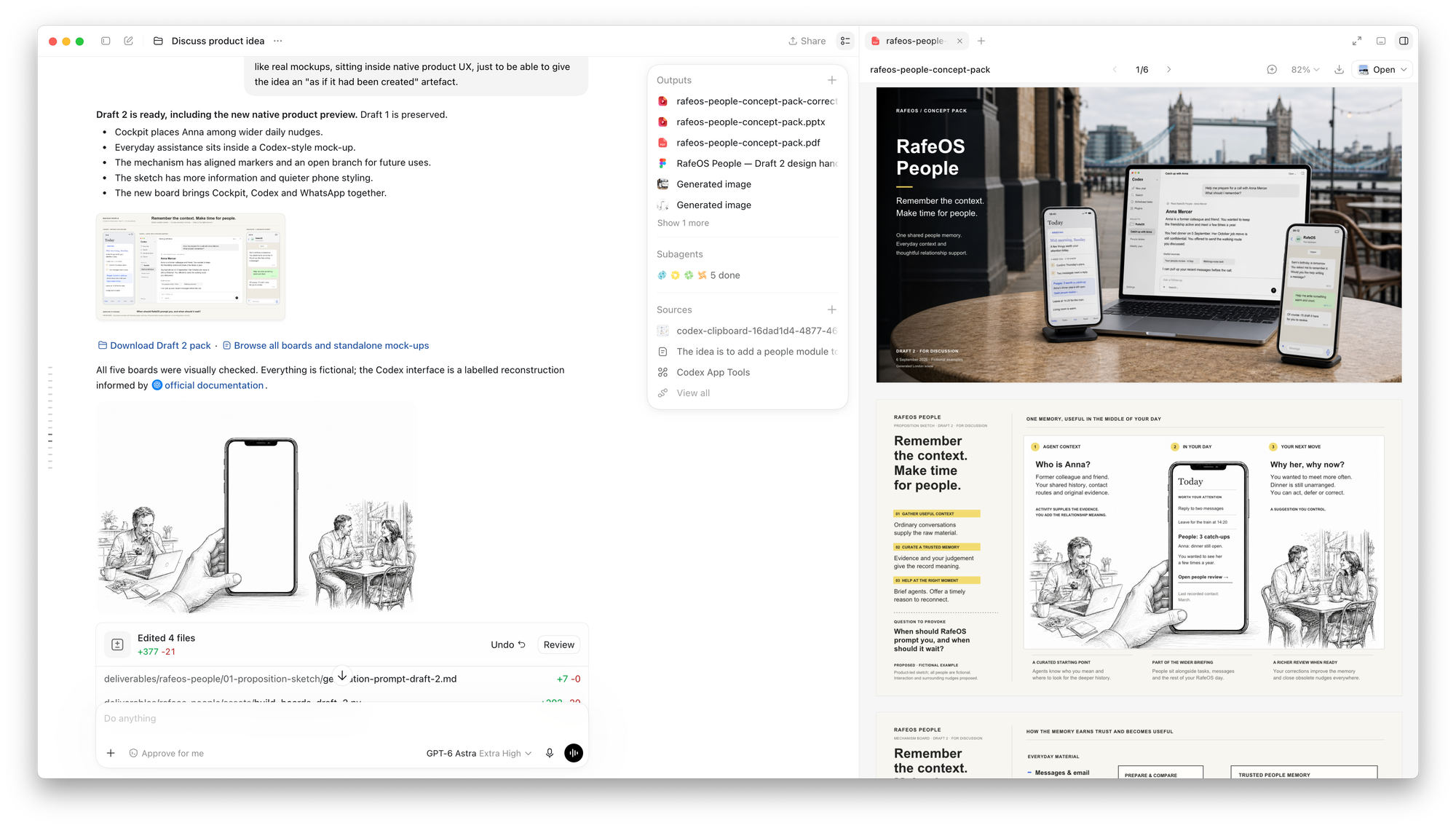
The boards helped separate several questions that had been tangled together. How should a people memory earn trust? What information should an agent retain? Where should somebody be able to inspect and correct it? When should RafeOS prompt, and when should it wait?
The artefacts did not answer those questions for me. They made the questions difficult to avoid.
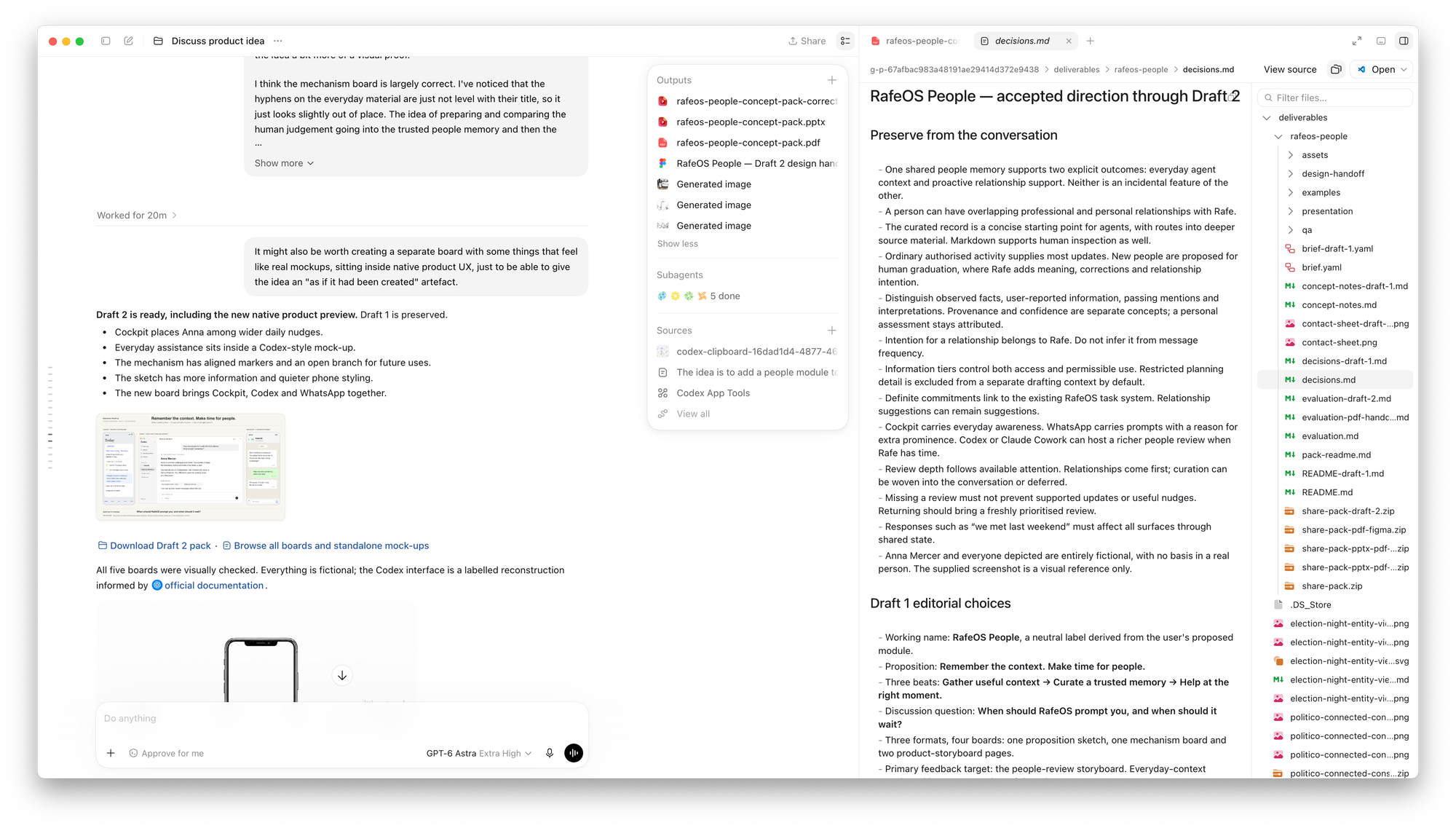
The pack does not end with the boards. The brief, accepted decisions, assumptions and evaluation are retained as Markdown. These files give the next person, model or tool a record of what changed and why, making later iterations easier.
Faster, with some important caveats
A typical generation or revision turn in my release testing took around 15 to 20 minutes. RafeOS People involved some upfront thinking and three main production turns, with human pauses between them. It amounted to roughly an hour of agent production time rather than an instant result.
I would previously have expected a comparable four- or five-board pack to take much of a day or longer. I have seen workshop ideas take two or three days to come back in a form ready to circulate. To be fair, those packs may also have contained more human judgement than this comparison captures. Even so, the compressed feedback cycle is useful.
More useful than the raw time saving is what happens to the process. You can involve stakeholders while the thinking is still fluid, explore more than one idea, run smaller loops in parallel and revise while the original conversation is fresh. This is a practical example of the argument I made in Loops within loops: when feedback cycles become cheaper, we can afford to run more of them.
Some work remains reassuringly human. Talking to users, interpreting what they need, making a values judgement, understanding organisational politics and deciding what deserves investment do not disappear because a model can draw a good board. Some friction is healthy; time to sit with an idea is a really important part of all product work.
There is some genuine discomfort in handing visual assembly to a machine. I am more comfortable doing that here because these artefacts are intentionally provisional and editable. A designer can take them further.
My judgement changed the examples in mundane visual ways: correcting a phone ratio, protecting a margin, untangling arrows and spotting overlapping text. More importantly, it changed which question a board was asking and whether the actual product idea was visible inside the drawing. Automated quality checks can catch the first category. The second is why human verification of agent work still matters.
The tools around the skill matter
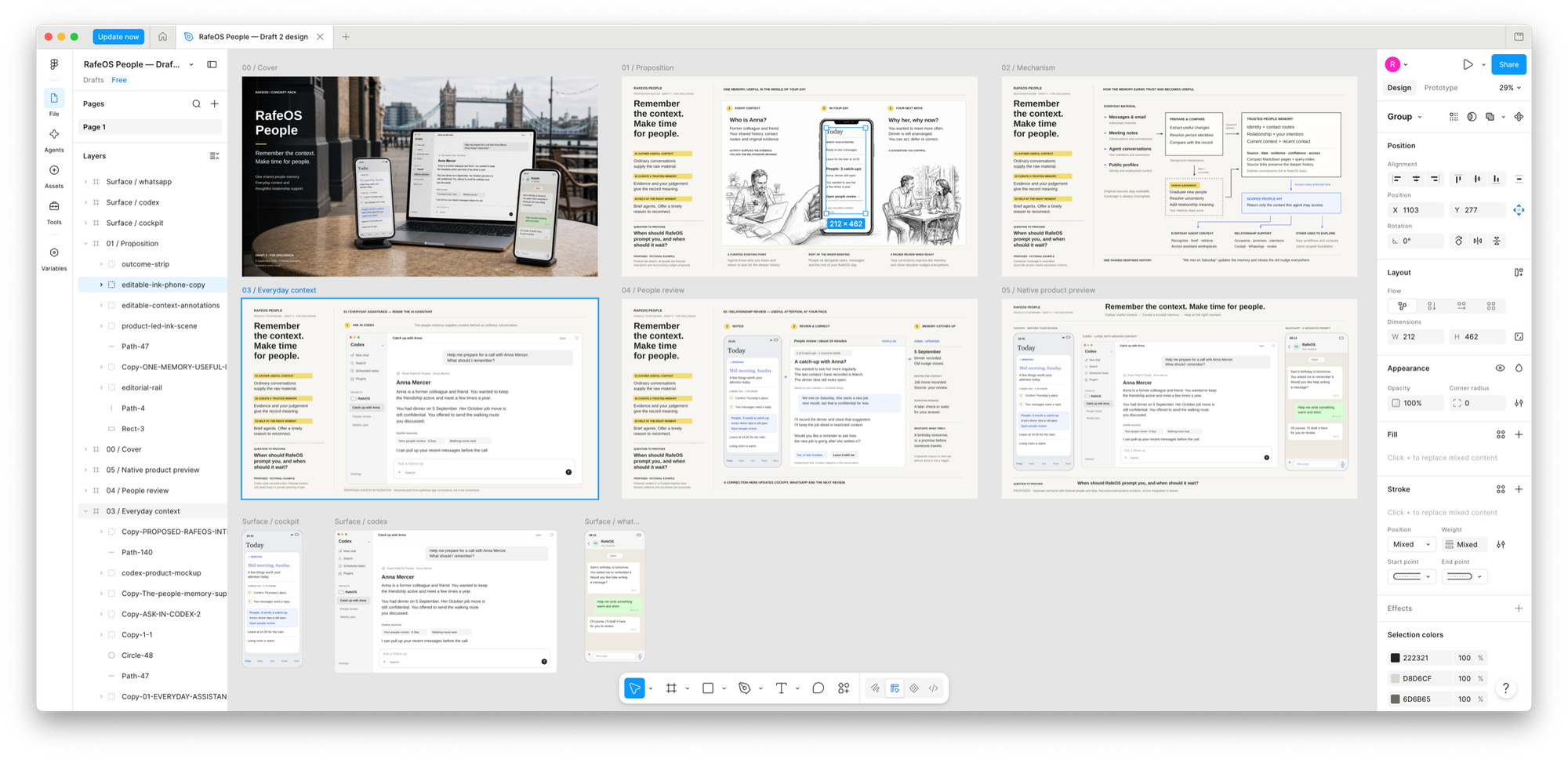
Product Idea Pack works best as part of a wider working environment. A workshop transcript can provide the source material. A research folder can supply context and references. A Figma connection can turn the output into a genuinely editable design hand-off rather than a file somebody has to reconstruct. PowerPoint and PDF make the same thinking easy to circulate.
I tested the skill across models in Codex and across Claude Code and Cowork. Codex was the strongest default for this particular workflow because its integrated image generation matters for the proposition sketches and storyboards. Claude can still use the method, but may need to prepare a prompt and hand image generation to another tool.
Made with AI, deliberately
Product Idea Pack draws on several threads of my own experience: product thinking techniques I have used in a decade of agency workshops, systems thinking, composable architecture, and the last two years of working collaboratively with AI. Experimenting with or building something remains one of the best ways I know to develop a real point of view on a technology, especially when everyone is feeling pressure to have one.
The skill itself was developed through human–AI collaboration. I set the intent, chose and refined the format taxonomy, critiqued the examples and decided what was "good enough". Codex and Claude helped research, draft, generate, test, package and implement it. The same collaboration helped produce this article.
The dominant product choices and judgement must remain human. I do not think the future of this type of work is a prompt going in and an unquestioned answer coming out. Instead, I think the useful approach is a tighter loop in which people make the important product choices and machines make the work visible more quickly.
Try it, then change it
Product Idea Pack is available now as an open Agent Skill. You can use it from an existing conversation, give it a prepared brief or ask it to guide you through the starting questions. It has been tested in ChatGPT/Codex, Claude Code and Claude Cowork, and it is deliberately structured so you can change the formats, visual treatment, templates and branding.
I am interested in what happens when other people bring different ideas, working styles and standards of judgement to it. Use it, disagree with it and adapt it. I hope it will help make an idea visible early enough that people can decide whether it deserves to be built.
New writing by email
Occasional pieces on product, technology and AI — and how they actually play out in practice.


