
Product Idea Pack
Open Agent Skill · Product thinking
Product Idea Pack turns a rough thought, a brief or a substantial conversation into visual artefacts that a team can inspect, challenge and revise.
It can create a proposition sketch, mechanism board, product storyboard or interactive prototype. The aim is not to make an early idea look finished. It is to make the important question clear enough for a useful conversation.
For the reasoning behind the skill and what I learned while making it, read Making product ideas visible before they look finished.
Current release: v0.1.2 · Released 7 September 2026 · Apache-2.0
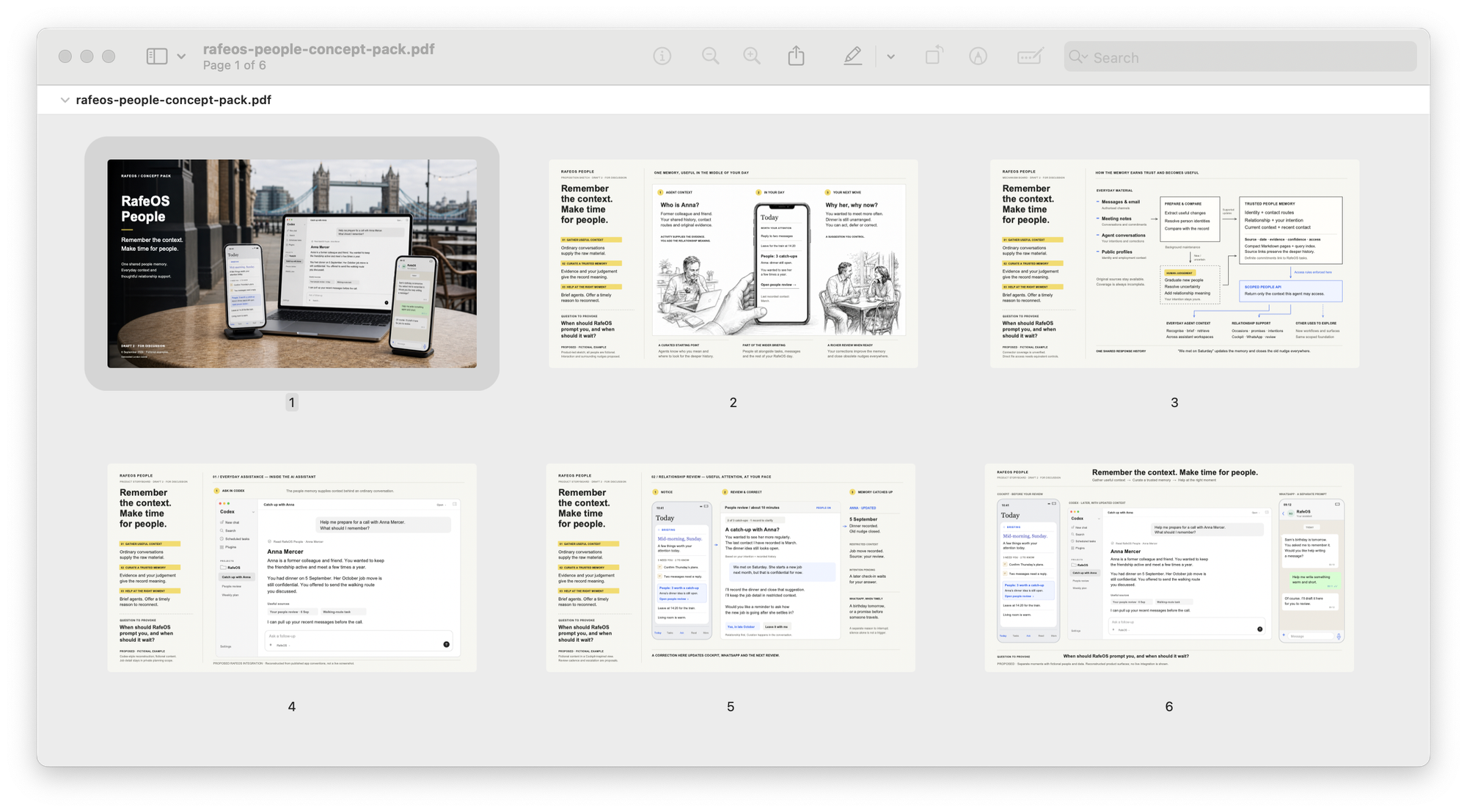
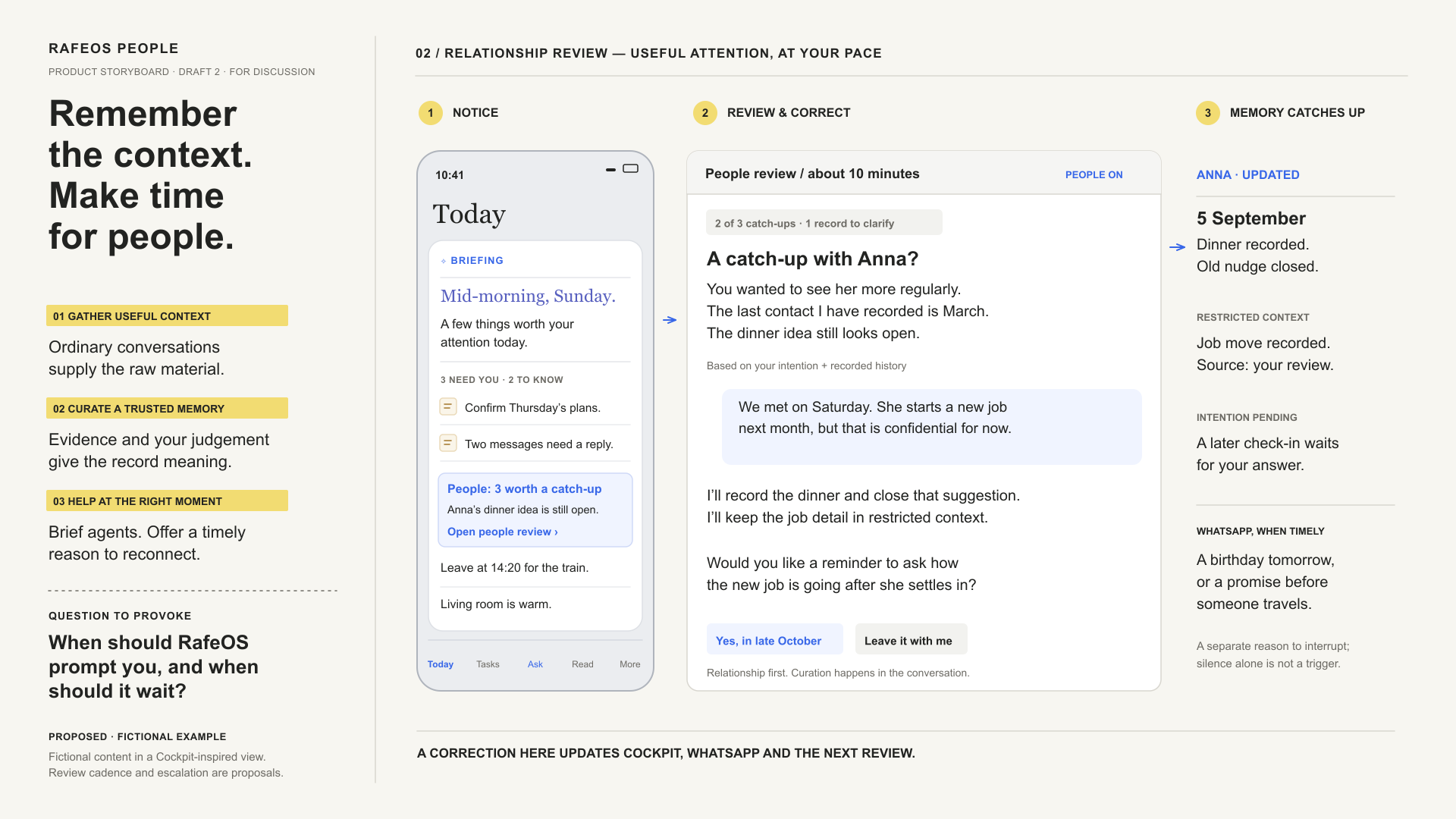
A complete six-page PDF and one finished product storyboard from the RafeOS People example.
A faster discussion object
Early ideas often stay in prose for too long, with everyone picturing something slightly different. Or they jump into polished interface design before the proposition and mechanism have earned that level of certainty.
Visual artefacts sit usefully between those two states. They make assumptions visible, turn disagreement into something specific and give stakeholders a shared object to react to.
You might use Product Idea Pack alone while shaping an idea. It also works well in a workshop: a group can talk through the proposition and quickly create a visually led record to share with colleagues and stakeholders while the discussion is still fresh.
Choose the question before the format
The four formats generally increase in fidelity and commitment, but they are not a compulsory four-step pipeline. Start with the question the idea needs to answer; stop, repeat or move backwards when that produces better learning.
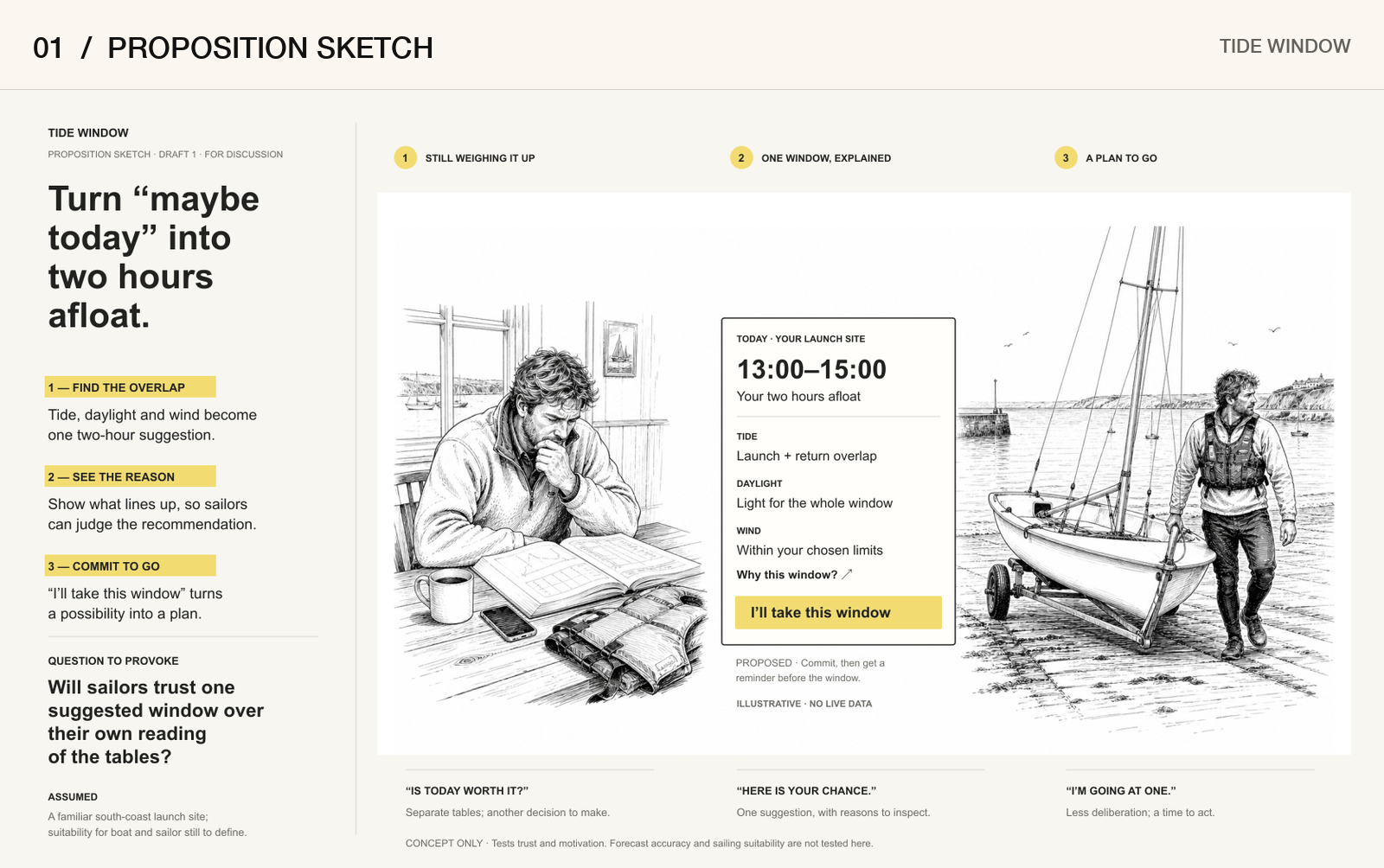
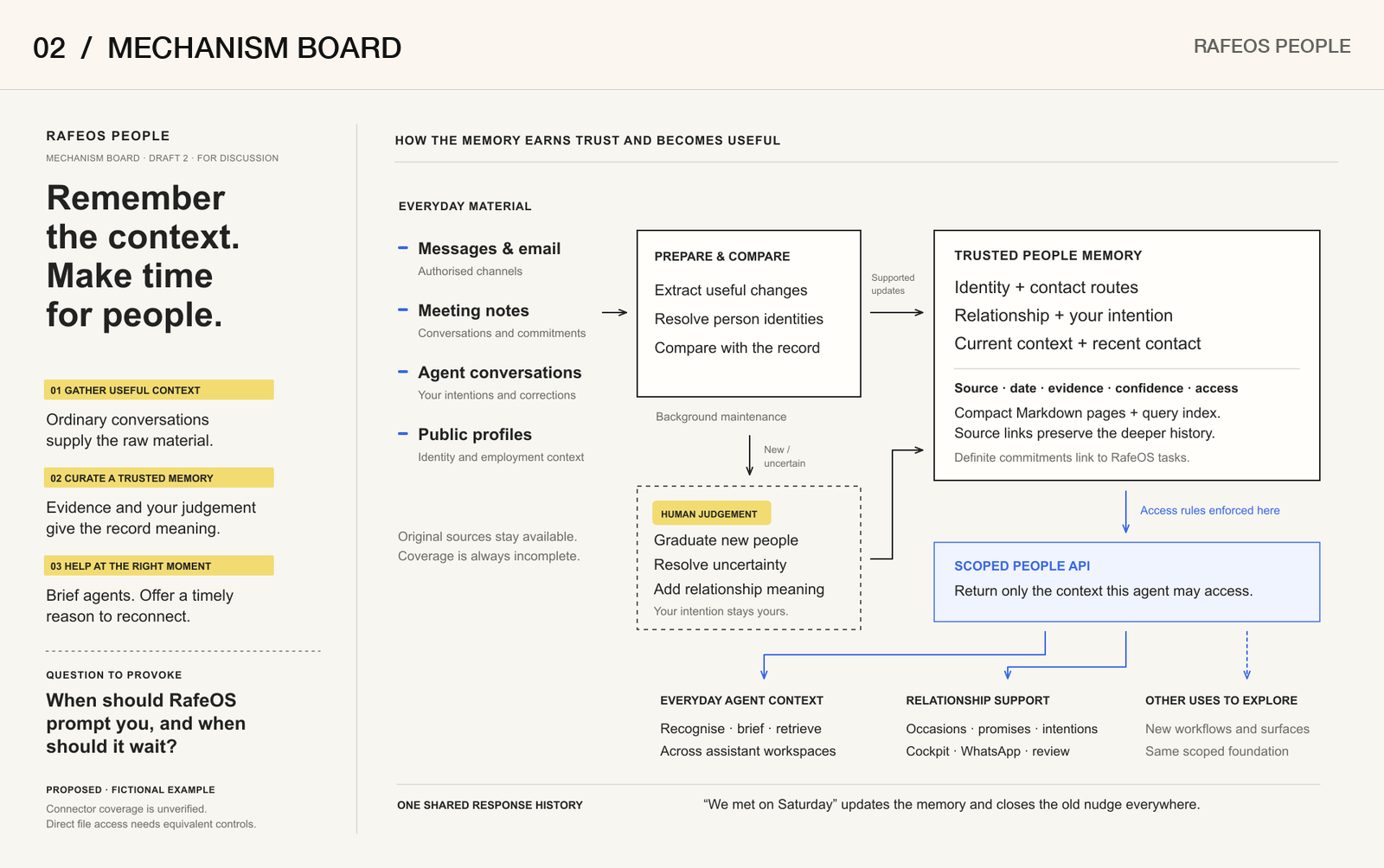
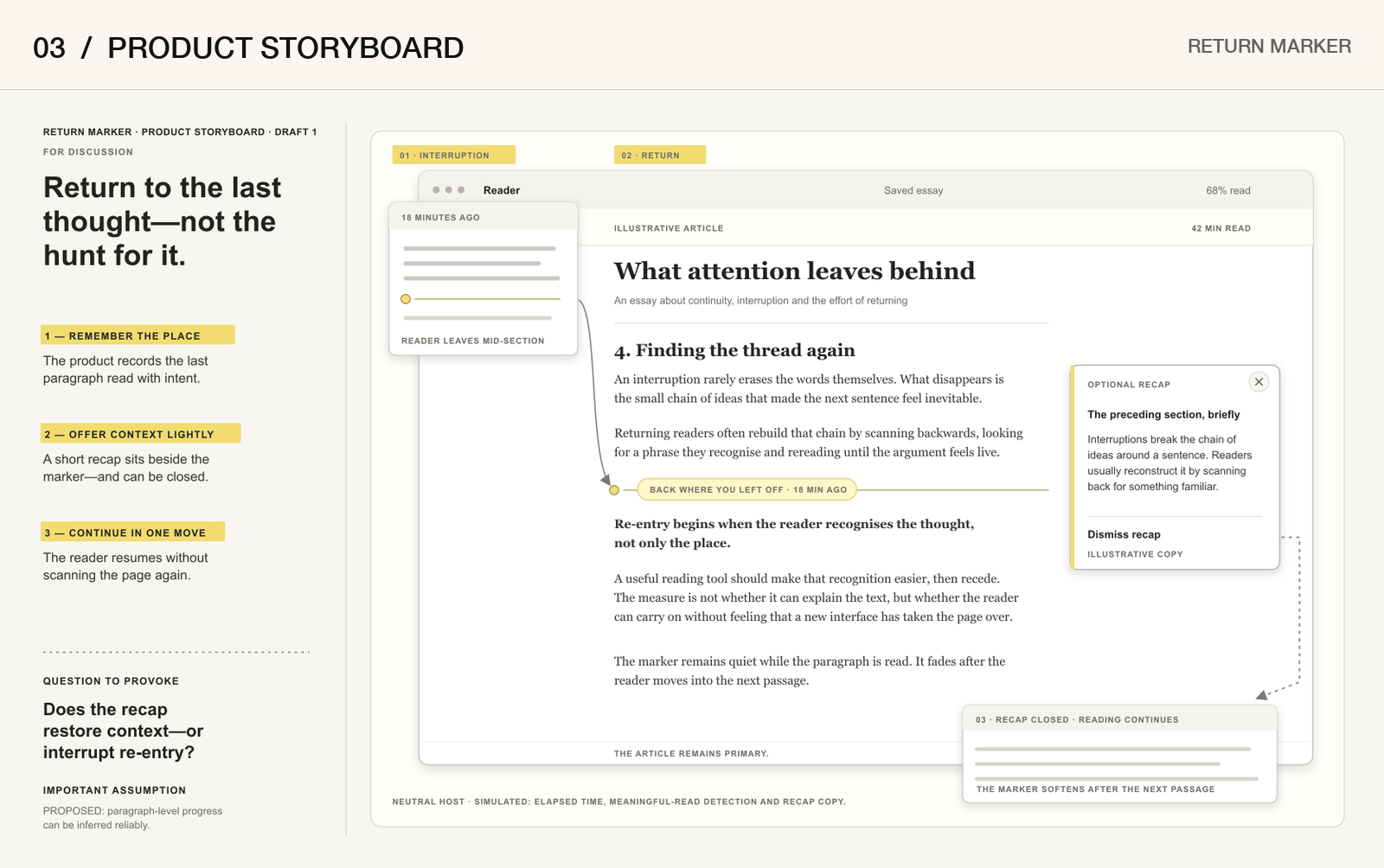
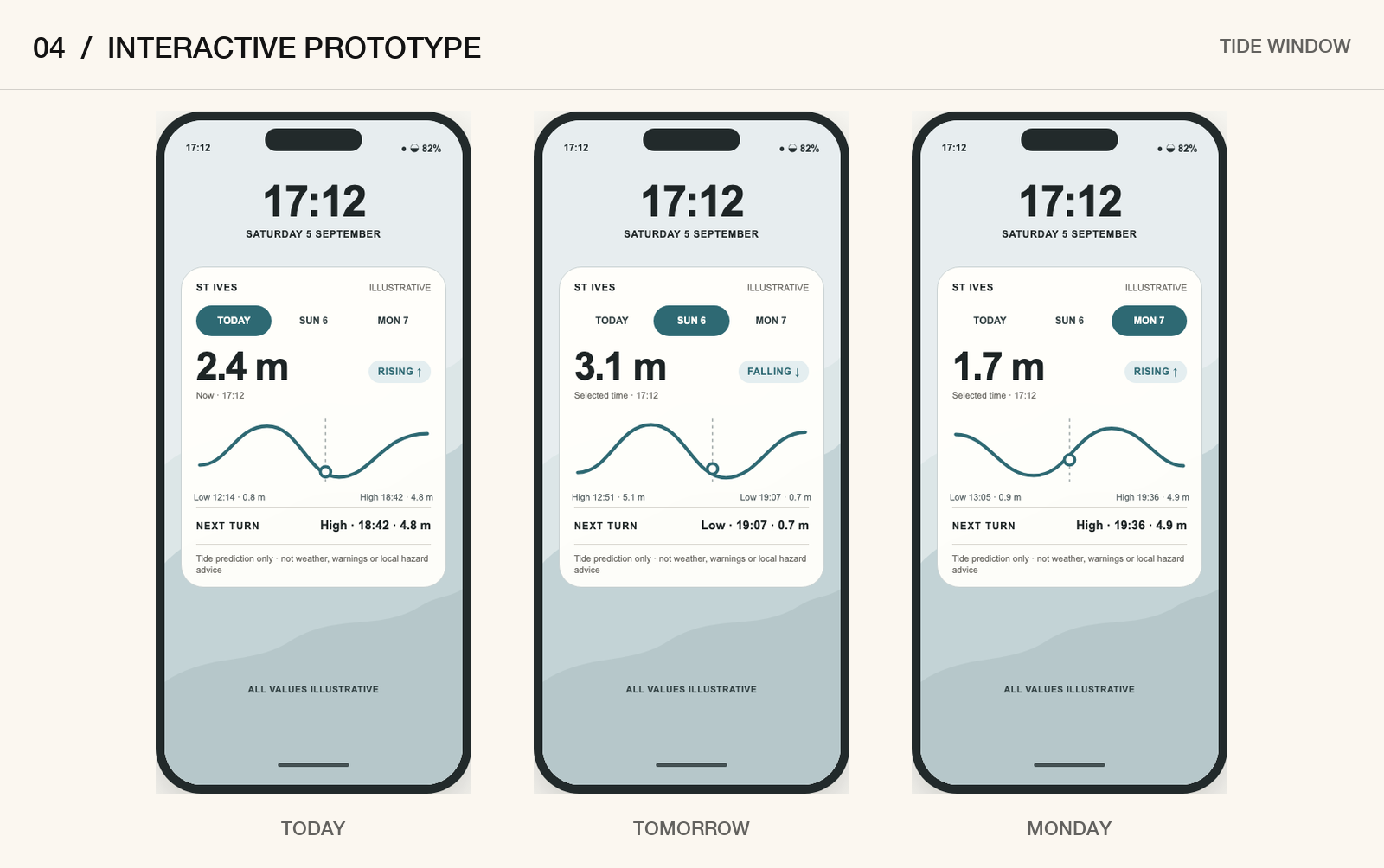
From top left: proposition sketch, mechanism board, product storyboard and interactive prototype. Each image opens at full size.
Proposition sketch
Is this an interesting change for someone?
A loose, scanned sketch-page that makes the proposition discussable before anyone critiques polish.
Mechanism board
How does it work, and where can it break?
An editable line-board for actors, hand-offs, dependencies, assumptions and weak links.
Product storyboard
Could this become a believable product experience?
Situated screens and moments that test whether the idea makes sense in somebody’s day.
Interactive prototype
Does it make sense when operated?
A self-contained HTML artefact for questions involving state, sequence, navigation or cause and effect.
What you get
Ask for one useful artefact or a coherent multi-format pack. Each static board arrives as a shareable PNG and editable SVG; an interactive prototype arrives as self-contained HTML. A pack can contain one format or several.
Context retained
- Brief and audience
- Decisions and assumptions
- Prompts and revisions
Requested outputs
- Proposition sketch · PNG + SVG
- Mechanism board · PNG + SVG
- Product storyboard · PNG + SVG
- Interactive prototype · HTML
Optional hand-offs
- Presentation · PowerPoint + PDF
- Design · Figma-ready vectors
Presentation and design hand-offs are optional. A PowerPoint/PDF pack is useful for stakeholder discussion; a vector hand-off makes the boards easier to continue in Figma. When the relevant tools are connected, the skill can carry more of that hand-off work directly.
A worked example: RafeOS People
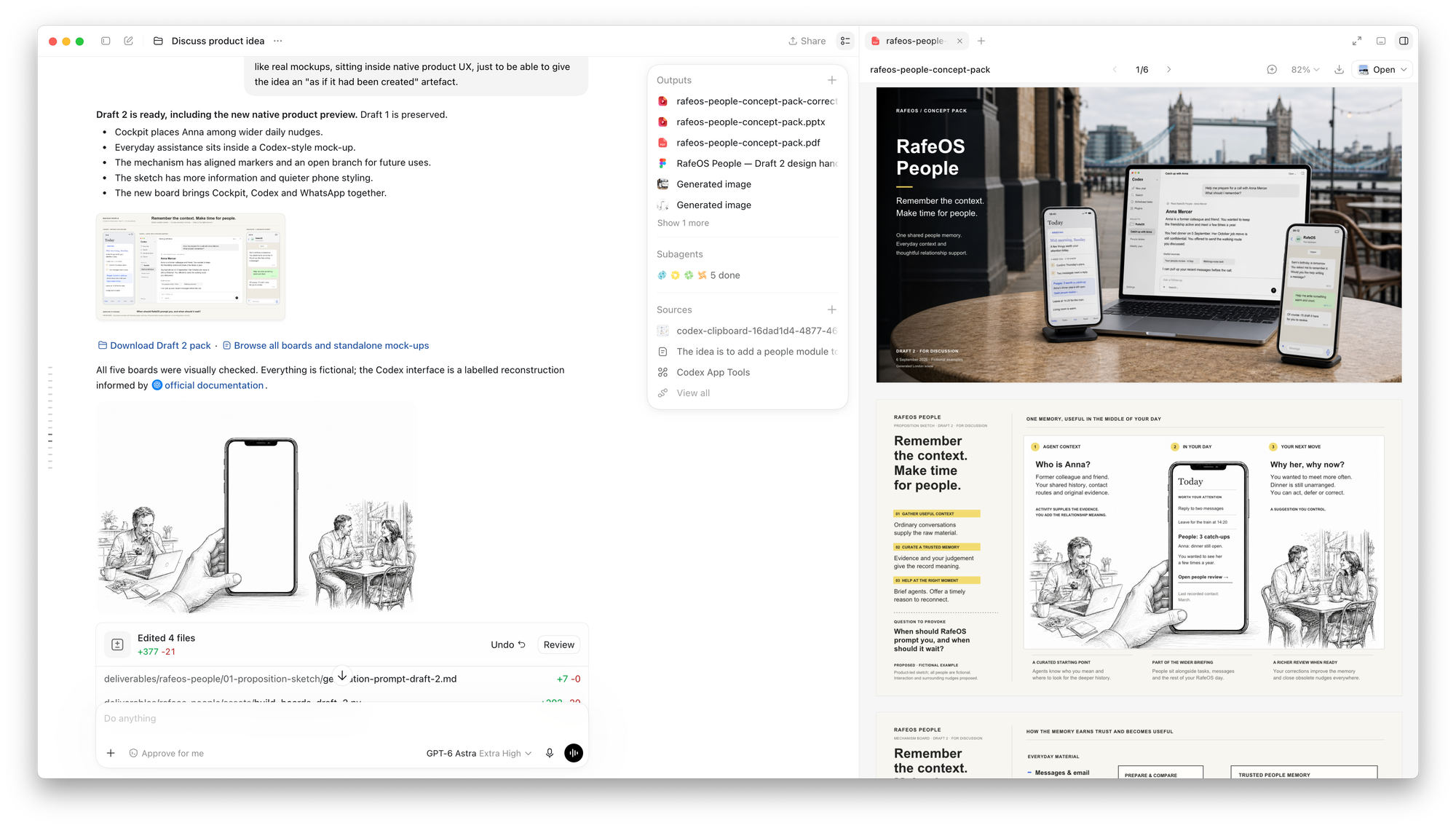
RafeOS People began with a longer conversation about how an assistant might remember useful context about people without becoming intrusive. The first visual pass led to one substantial human-directed revision and a second tidy-up. The finished example contains a cover, proposition sketch, mechanism board, two product storyboards and a native product preview. It also includes the original conversation, brief and decisions, plus a PDF and editable Figma hand-off.
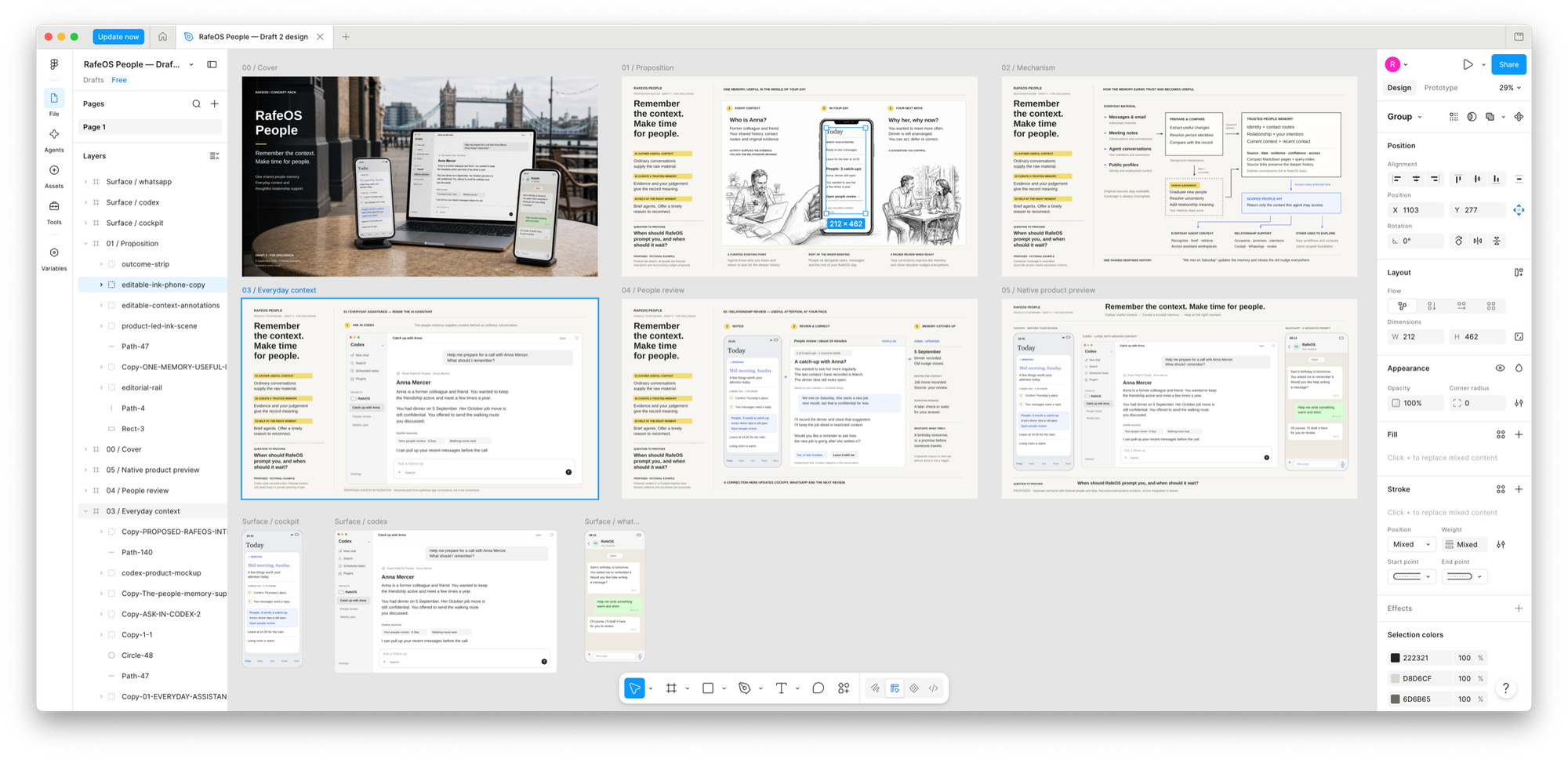
A typical generation or revision turn takes about 15–20 minutes in the release tests. This example also had about 15 minutes of upfront thinking and three 10–15 minute production turns, with human pauses between them. Allowing for some further human refinement, I would estimate that a comparable multi-board pack would take between 5x and 10x the amount of time to produce manually.
Other examples
- Tide Window — a one-shot proposition sketch followed by a later four-format revision, including an interactive prototype;
- Return Marker — a specific feature captured in one pass, with zero human feedback rounds;
- RafeOS Delta Brief — a compact, multi-state interactive prototype.
Three ways to begin
You can invoke the skill after a substantial discussion, bring it a structured brief, or ask it to help shape a rough idea. More context and purposeful references give you more control; thinner inputs leave more for the agent to infer.
Continue a conversation
The conversation—or a transcript from a recorded discussion—may already contain the audience, tension, mechanism and open questions.
Use Product Idea Pack to turn the conversation above into the format that best exposes the unresolved product question.
Bring a brief
Use Product Idea Pack.
Idea: …
Audience: …
Question we need to answer: …
Constraints or references: …
Desired format, if known: …
Ask for a guided start
Use Product Idea Pack to help me shape this rough idea. Infer low-risk detail and ask when a human decision would materially change the direction.
Revise it with judgement
The first output is deliberately called Draft 1. Treat it as stimulus. Check that it expresses the actual idea, that arrows and relationships are clear, that nothing is cramped or overlapping, and that it will make sense to the people who need to react to it.
One or two focused critique rounds are often enough to produce a stronger, audience-specific artefact. Speed changes the economics of the work; it does not remove the need for product, editorial or design judgement.
Customise and extend it
The skill separates the method, four format guides, shared house style, templates, optional presentation modes and brand profiles so that each layer can be changed without rewriting the others.
- Branding is opt-in. Copy the included Rafe Blandford example to add your own marks, wordmark and placement rules.
- House styles control the visual language. Change colour, typography and graphic character without changing the method.
- Templates control recurring structures. Adapt them when your organisation needs a different board or layout.
- Additional boards are welcome. They are stronger when accepted sketches, mechanisms or storyboards provide context and visual reference points.
Where it works... and its limits
Product Idea Pack uses the open Agent Skills format and has been tested in ChatGPT/Codex, Claude Cowork and Claude Code. Integrated image generation makes Codex the strongest default for proposition sketches and product storyboards; the same core method remains usable elsewhere.
The quality of the result depends on the idea, the context already present, the specificity of the brief, useful references, the model and the capabilities available in the agentic harness, and the experience of the human user. It accelerates product thinking and concept capture; it is not a substitute for research, design specification, prioritisation decisions, or human judgement.
Open and inspectable
Product Idea Pack is available under the Apache 2.0 licence. Use it, change it and make derivatives. You do not have to tell me, but I would be pleased to hear what you make or modify.
It was itself created through human–AI collaboration. I set the product intent, format taxonomy, visual system, workflow approach, critique and release decisions; Codex and Claude agents helped with research, drafting, generation, testing and implementation. That provenance is documented because it is part of understanding how the work was made.