
A front door for people and machines
Two audiences now: the bifurcation the web and how this site looks to address this.


ChatGPT has, as of June 2026, around 1 billion people using it every month, Google's Gemini is around 700 million, and Claude is climbing fast behind them. Whatever else you think about generative AI, its adoption is the fastest of any consumer technology in history, and a large and growing share of people now ask a model rather than a search box.
So when I rebuilt this site, I made a decision that would have sounded slightly mad a couple of years ago: I designed it for two audiences. People, obviously. But also the machines that, increasingly, read the web on people's behalf.
The web has always served many audience (including bots), but we are now looking at a more deliberate bifurcated system, and it will accelerate over the next few years. Once you accept that a meaningful share of "readers" are now models, summarising and answering and citing rather than browsing, the conclusion is fairly obvious: a site has two audiences now, and they read very differently.
What's odd is the shape of the second audience. The human one is potentially billions of people. The machine one, in theory, is no more than a dozen or so frontier models. A tiny, strange readership… with enormous reach. That asymmetry is most of what makes this interesting (and "in theory" is doing some quiet work in that sentence, which I'll come back to).
Letting the machines in
The first decision is whether to let the crawlers in at all. A lot of sites are now blocking the AI bots, and for understandable reasons: if your content is your business, you don't necessarily want it ingested for free.
I went the other way and welcomed them explicitly, training crawlers included. There's some ambivalence in that, of the "you're building on my words" variety, and I suppose "making money from my work". But I don't think blocking is either pragmatic or realistic, and more to the point, I actually want my views in the training corpus. The value of an opinion, to me, is in how widely it travels. If a model has read what I think, and occasionally repeats it, that is rather the point.
Telling them who I am
Then there is helping a machine work out who is actually writing this. That is the structured-data work: schema, a connected description of me and what I've done that a machine can resolve rather than guess at.
None of this is new advice. It has been the sensible thing to do for years (I spent a fair bit of the All About Symbian archive work building exactly this kind of author authority, for a site that had long stopped publishing). But it is a useful reminder that machines read differently to us. A person reads the page; a machine reads the page, and the markup, and the links, and tries to decide whether you are a real, consistent entity worth trusting.
A map for the machines
The genuinely new bit, the unproven bit, is something called llms.txt: a plain, structured map of the site written for language models rather than browsers. A short index, plus the full text, in one place they can grab.
I'll be straight about the uncertainty. Only about one site in ten has adopted it, and the AI search crawlers mostly ignore it: in one large analysis it was fetched in roughly 0.1% of AI-bot visits, and no major lab has committed to reading it. So as a search play, it is hedging a cheap bet more than backing a sure thing.
What makes me a little more interested is a different use altogether. The tools that do already read llms.txt are the agentic ones: Cursor, Claude Code, Copilot and the like pull it when you point them at a site. That suggests its real value is not search at all, but a fast way to hand a site's live, in-the-moment context to an assistant on demand. Point your tool at a site, pull its llms.txt, and you can more or less start a conversation with it (or have it discovered) in seconds. That feels more useful, and more likely to stick.
How it's made... and saying so
The part I care about most is not really optimisation at all. It's provenance.
There is already a great deal of AI-generated content, and there is about to be far more. By late 2025, some research suggests that more than half of newly published web articles were primarily AI-generated, with "slop" being word of the year. The trust problem is worse than the volume problem: NewsGuard is now tracking over three thousand AI-generated "news" sites that publish without ever disclosing it.
So I've labelled every piece on this site by how it was made: by me, with AI, or by AI. I think that labelling matters. Collaboration with a model does not automatically mean slop.
The difference between useful and slop is human judgement and integrity, but it is a subjective and grey area.
I'd go a bit further, because this is one of the things I'm most worried about. The commercial incentives around content have never really rewarded transparency, and the last decade of the internet is a fairly bleak lesson in what happens when they don't. I don't have a neat answer. But labelling my own work transparently is at least a position, and it costs me nothing except the temptation to look cleverer than I am.
Then I set up a way to find out if it works
Most of this could be wishful thinking, so I wired up some measurement: server logs for crawler activity, referrers for the humans arriving from AI answers, and a small weekly report so I don't have to remember to look.
It is already visible, and the most interesting evidence comes not from this site but from the much longer-established All About archive. While content stopped being actively published on the All About sites some years ago, it still serves around five hundred requests a day to crawlers. Most of those are the long-established search bots (Googlebot does the heavy lifting, and these days it feeds both search results and AI overviews), but a clear and growing slice is the dedicated AI crawlers: OpenAI's, ByteDance's, and others.
The machines are sending people back. Over the last three months the archive has had visitors arriving from ChatGPT (more than 150 of them), with smaller numbers from Gemini, Perplexity, Claude and Copilot. And, of course, it's fair to note that many more consumed the content, or at least a shadow of it, within the respective AI assistant (a 1%-2% click through rate suggests there are thousands of content consumers that never reach the site).
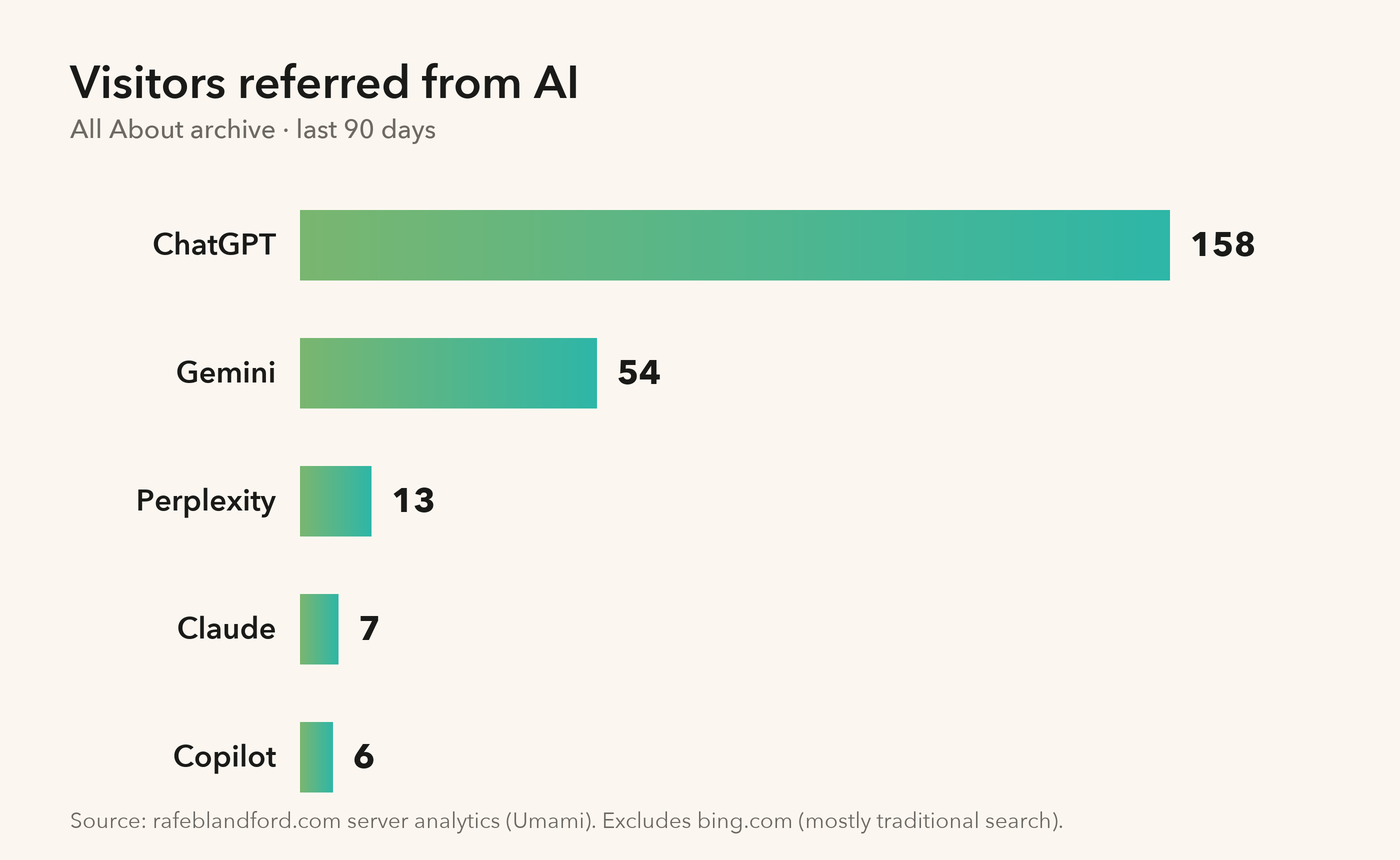
On reflection, none of this should surprise me. The archive has two decades of authority built into it, the very defintion of domain expertise and depth.
So is this all just SEO?
Mostly, yes. I keep waiting for the new magic and mostly find old discipline: clean markup, structured data, clear writing, and being a genuine authority on something. It is really a continuation of the zero-click web (around 60% of Google searches now end without a click, rising to roughly 83% when an AI Overview appears). The answer arrives without the visit.
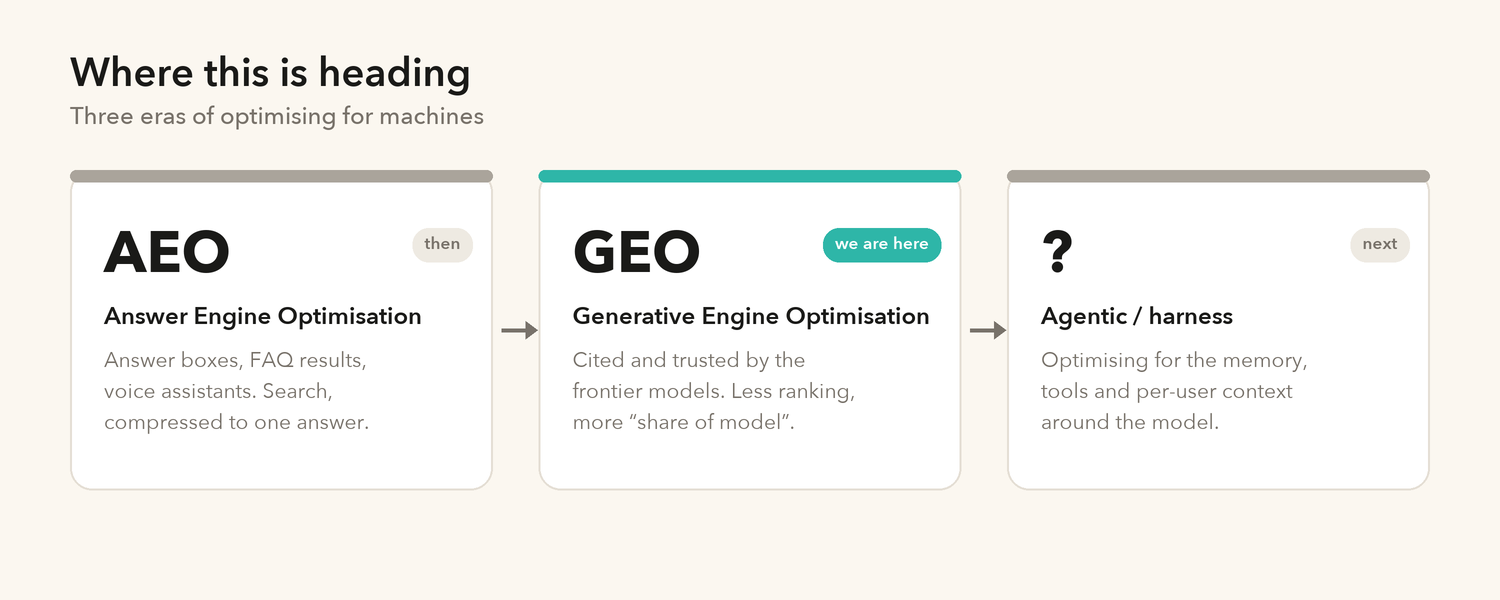
But the acronyms are worth untangling, because they mark a real shift. Answer engine optimisation (AEO) has actually been around a while: it is what you did to land in a Google answer box, an FAQ result, or a voice-assistant reply, which is really search compressed to a single answer. Generative engine optimisation (GEO) is the newer thing, and it is most of what I've described here: getting your content cited, and your view trusted, by the frontier models. Less ranking in ten blue links, more citations, and something like share of model and AI visibility. Much of it still comes down to two things: how you structure content, and where your authority is built. And the weight of those are changing, respectively, the shape and feel of content itself (modular, self-contained, shorter), and the importance of off-site activity (the citations and mentions elsewhere that tell a model you are worth trusting).
Looking a little further out, I suspect GEO will itself give way to something I don't yet have a tidy name for: optimising not for the models, but for the harness around them. The per-user context, the tools, and memory that increasingly sit between a person and a raw model. This is where "in theory, a dozen frontier models" stops being true. An agent's behaviour may depends less on which model is underneath and more on how its particular user has set it up. Which would be a quietly funny outcome: we might yet still end up back where we started, trying to be useful to one person, and their assistant, at a time, albeit with a very different equation making up the stack.
For now, I've built my personal web front door for both audiences, labelled my work honestly, and set up a way to watch what happens. I'll report back when the data has something to say.
New writing by email
Occasional pieces on product, technology and AI — and how they actually play out in practice.


