
What 449k forum posts tell us About Symbian
Stats from the restored AAS forum: what 449,000 posts reveal about the rise and fall of a technology community — things no market-share graph captures.


Having recently restored the AAS forum, a fun extra projects was to generate some stats to get an after-the-fact sense of what was happening (and another excuse to use Claude Code for a micro-task).
The shape of a community
Go to the stats page and look at the posts-per-month chart. It shows something that no market share graph or analyst report captures: the lived experience of a technology community.
The line rises steeply from mid-2001, peaks violently in 2003, sustains a long plateau through 2007, then falls away — slowly at first, then rapidly — to almost nothing by 2013. If you know the history of Symbian, every inflection point makes sense. If you don't, the chart tells the story anyway.
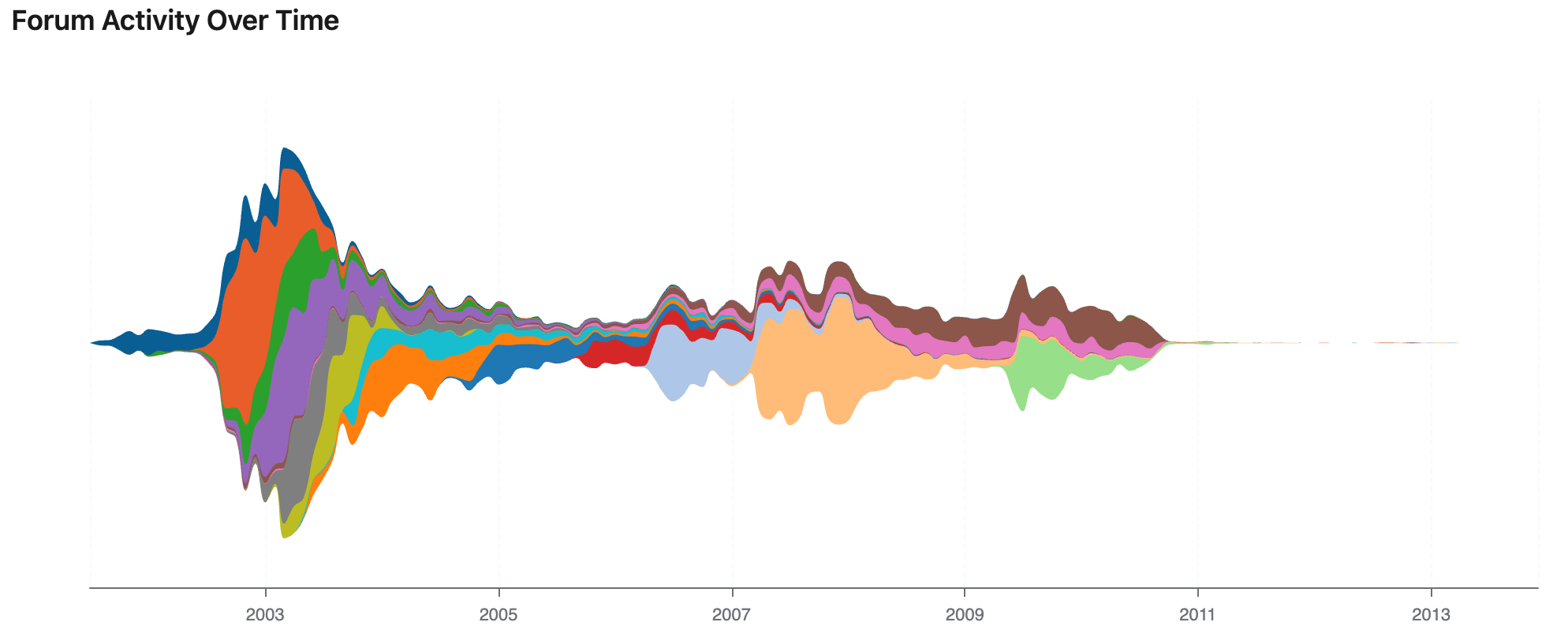
This is what 449,000 forum posts look like when you plot them. Not pageviews or downloads or revenue — conversations. People helping each other, arguing about firmware, sharing things they'd made. The shape of a community.
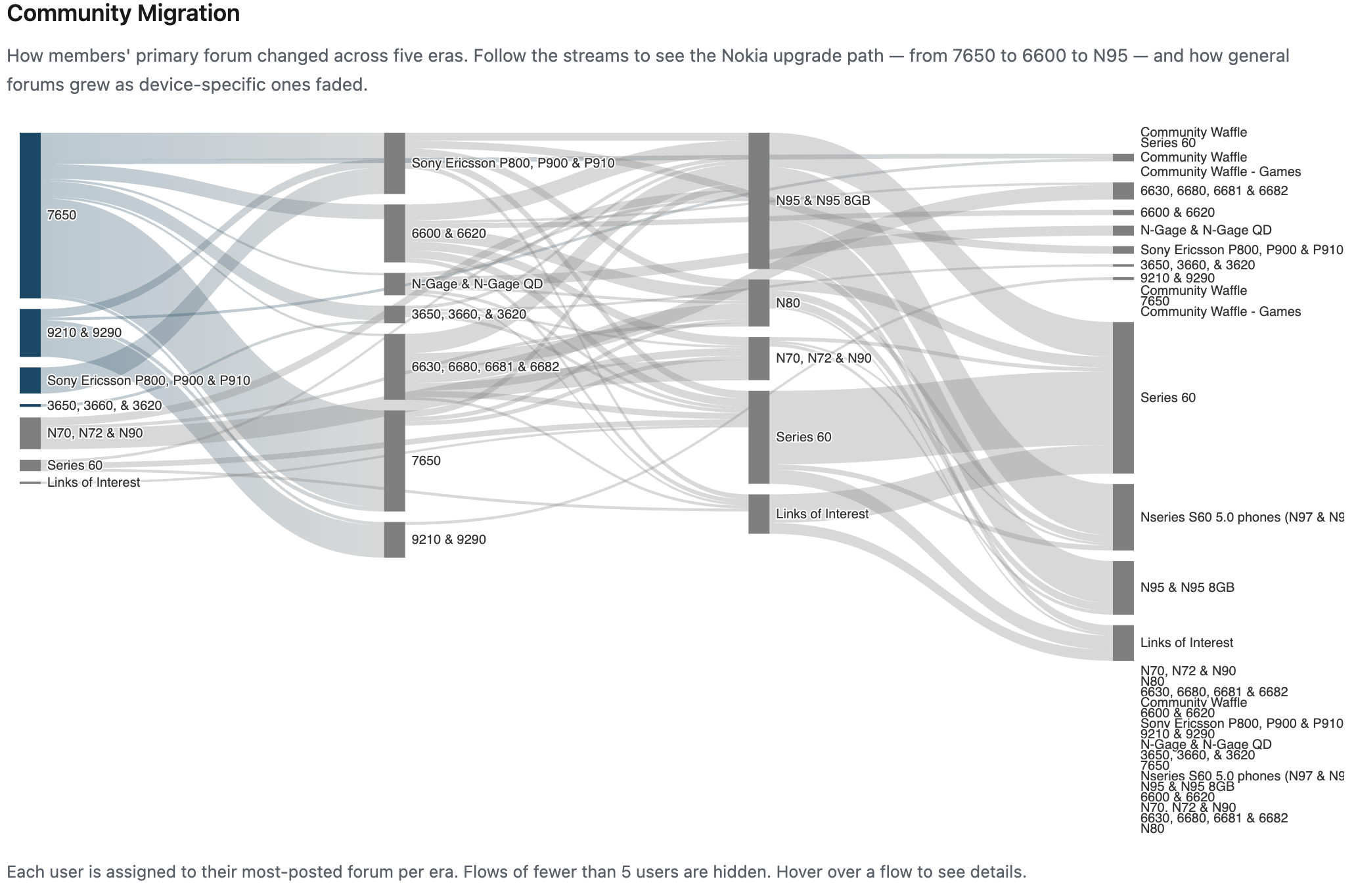
Other stats show how forums interacted with each other, evolved over time, and who were the top users.
Three eras
The Early Web Forum (2001–2002): 341 threads in the first year. The Nokia 9210 and 7650 forums. A small, intensely technical community. Posts are long, detailed, often from people who'd been using Psion devices since the 1990s. The phpBB-era legacy markers ([addsig], inline smilie paths) are visible in the earliest posts. The Nokia 9210 forum — a communicator with a full keyboard and colour screen — accumulated 15,480 posts and 2,446 threads, making it one of the most active forums in the archive despite being for a device most people have never heard of.
The Smartphone Boom (2003–2007): The Nokia 6600 arrives and the forum explodes. 103,000 posts in 2003 alone. New device forums are created monthly. The Nokia 7650 forum accumulates 4,430 threads and 34,206 posts — more than many entire forums. The community is global: posts reference currencies from Nokia pricing in India, carrier-specific firmware for European networks, availability dates in the US. The peak of forum culture coincides with the peak of Symbian — this was how you learned to use your phone.
The Sony Ericsson P800/P900/P910 forum is a surprise in the data: 31,266 posts, making it the fourth most active forum. The UIQ platform never had the market share of S60, but its community was passionate and concentrated in a single forum.
The Long Decline (2008–2013): The iPhone launched in June 2007. The forum's monthly post count doesn't drop immediately — the N95 sustains activity through 2008. But the trajectory changes. Nokia's response (the N97, the slow Symbian^3 rollout, the eventual pivot to Windows Phone in February 2011) plays out in real-time in the thread titles. The February 2011 "burning platform" announcement is visible as a cliff edge in the posting data. By 2013, the forum was producing 732 posts for the entire year — less than the community managed on a single busy day in 2002.
What people actually talked about
The most active forums tell you what mattered:
| Forum | Posts | Threads |
|---|---|---|
| Nokia N95 and N95 8GB | 41,785 | 6,181 |
| Nokia 7650 | 34,206 | 4,430 |
| Series 60 (general) | 33,355 | 2,752 |
| Sony Ericsson P800/P900/P910 | 31,266 | 5,184 |
| Nokia 3650/3660/3620 | 19,413 | 3,306 |
| Nokia 6600 and 6620 | 19,160 | 3,288 |
The most-viewed threads reveal the forum's real utility. These weren't discussions — they were living reference documents:
- N73 firmware versions (780,000 views) — a community-maintained tracker of every firmware release for every product code
- N95 firmware versions (675,000 views) — the same, for the N95
- N95 product codes for debranding (646,000 views) — how to flash your carrier-locked N95 with generic firmware
- "Full phone formatting a 6600!" (427,000 views, 204 replies) — a troubleshooting guide that became the definitive reference
This was the pattern: someone would create a thread to document something, and the community would keep it alive for years, adding firmware versions as Nokia released them, noting which product codes worked with which carriers, flagging problems with specific updates. It was collaborative documentation, maintained by volunteers, before wikis were mainstream.
The general discussion forums reveal the community's personality. "Community Waffle" was the off-topic forum — 17,211 posts, but in only 1,246 threads, meaning long-running conversations. Its gaming subforum had 13,174 posts across just 42 threads, dominated by word games and forum games ("Let's Play!" had 2,399 replies, "This or That?" had 1,184). These were the threads that turned a tech support forum into a community.
The devices that defined eras
| Device | Forum Threads | Peak Year | What It Represented |
|---|---|---|---|
| Nokia 7650 | 4,430 | 2002 | The first real camera phone |
| Nokia 6600 | 3,288 | 2003 | Symbian goes mainstream |
| Nokia N95 | 6,181 | 2007 | The everything phone |
| Nokia N97 | 1,716 | 2009 | The beginning of the end |
| Nokia N8 (Symbian^3) | 957 | 2010 | The last stand |
The N95's forum is the largest by a wide margin — 41,785 posts, nearly 20% more than the 7650's forum despite covering a shorter period. The N95 was the phone that tried to do everything (5MP camera, GPS, Wi-Fi, video calling, music player) before the iPhone simplified the category. The forum reflects that ambition: threads about GPS navigation, firmware bugs, video encoding, Bluetooth accessories, and the endless debate about whether the N95 or iPhone was the better device.
The N97's forum is poignant. Nokia positioned it as the N95's successor, but the 1,716 threads are full of frustration — resistive touchscreen complaints, performance problems, software bugs. The thread titles shift from "how do I" to "does anyone else have this problem." You can read the moment Nokia lost the community's confidence.
The community's notable contributors
The top 15 posters account for a remarkable share of the forum's content:
| Username | Posts | Active |
|---|---|---|
| slitchfield | 7,002 | 2002–2013 |
| GhostDog | 6,356 | 2002–2005 |
| Rafe | 6,084 | 2001–2013 |
| nj7 | 3,747 | 2006–2010 |
| Jadeviper | 3,119 | 2003–2006 |
| Ewan | 2,988 | 2001–2011 |
| J2theIZZO | 2,719 | 2002–2008 |
| kontraband | 2,666 | 2006–2012 |
| bartmanekul | 2,653 | 2007–2010 |
| Gadget17 | 2,618 | 2002–2010 |
Steve Litchfield (slitchfield) posted consistently for over a decade — 7,002 posts from 2002 to 2013. He was also a prolific contributor to the main AAS site, writing hundreds of in-depth reviews and software roundups. GhostDog was intensely active for a shorter period, averaging over 5 posts per day during 2002–2005. Ewan Spence (Ewan) was another AAS editor whose forum presence spanned the entire Symbian era.
What stands out is how many of these contributors stayed for years. This wasn't a site where people asked one question and left. The top 40 contributors all posted for at least two years, most for five or more. They were the backbone of the community — the people who answered the same questions patiently, maintained the firmware threads, and kept the conversation going.
What's lost and what's preserved
No archive is complete. Here's what we have and what we don't:
Preserved:
- Every public thread and post (449,030 posts across 76,783 threads)
- The complete forum hierarchy (88 forums in a 3-level structure)
- 3,929 file attachments, including 341 Symbian .sis application packages that likely don't exist anywhere else on the internet
- Community statistics: who posted, when, how much
- The full text of every discussion, fully searchable
Lost:
- User avatars and profile images (stored on the server filesystem, not in the database)
- Some icon images from the earliest posts (lost in a previous server migration, replaced with grey placeholders)
- User profiles and signatures
- Private messages (excluded for privacy)
- The interactive elements — polls, reputation, thanks — that made it feel like a living community
The .sis files are perhaps the most historically significant artefact. These are Symbian application packages — the installable apps that people built and shared with each other. Most Symbian app download sites are long gone. The forum attachments may be the last copies of some of these applications.
Reading the archive
The forum archive is at allaboutsymbian.com/forum/. You can browse by the original forum structure, search across everything with Pagefind, or start at the stats page to see the community's timeline.
The data tells a specific story — of a technology that defined the smartphone, a community that formed around it, and the inevitable transition that followed. But the individual threads tell thousands of smaller stories: someone in 2003 figuring out how to get Bluetooth working between their Nokia and their laptop, someone in 2007 excitedly posting first impressions of the N95, someone in 2011 asking whether it's time to switch to Android. These are the kinds of conversations that disappear when forums go offline. Now they won't.
New writing by email
Occasional pieces on product, technology and AI — and how they actually play out in practice.


