
Modernising the archive: what the search data says
Static, schema, Lighthouse to the top marks — did Google notice? Sixteen weeks of Search Console data on 145,000 modernised pages.


In late March I migrated three mobile technology sites — All About Symbian, All About Windows Phone, and All About Mobile, 24,000 articles across roughly 145,000 pages — from a dying legacy server and LAMP code base to a modern static archive. I've written about how the migration was done, the optimisation passes that followed, and adding structured data at scale. This post is about what happened next: whether any of that work shows up in Google's treatment of the sites.
What changed, in SERP-signal terms
Preservation was the goal, but the side effect was a full modernisation of everything Google's documentation says it cares about:
- Static delivery. Dynamic CMS pages on ageing PHP became pre-rendered HTML behind a CDN. Time-to-first-byte and reliability improved overnight, and there is no longer an application layer to fall over mid-crawl.
- Core Web Vitals and Lighthouse. The first optimisation pass took a representative page from Performance 71 / Accessibility 66 / Best Practices 73 / SEO 83 to 93 / 91 / 96 / 100. Subsequent passes pushed further: today the All About Symbian homepage audits at 96 / 100 / 100 / 100 on mobile emulation.
- Structured data at scale. From basic Article microdata to comprehensive JSON-LD across six content types — 4,504 review pages with proper Review schema, 81,117 forum threads with DiscussionForumPosting and comment markup, breadcrumbs on 23,000 pages.
- Crawl hygiene. Sitemaps resubmitted, thousands of 404s and deprecated-schema warnings worked through as Search Console flagged them.
None of this changed a word of content. The archive is frozen — no new posts, no updates, no promotion. Which makes it an unusually clean setting for the question: does technical quality alone move search performance?
What Google did
Search Console was set up the day after cutover, so the data starts with the modernised archive's first day — sixteen weeks of it now.
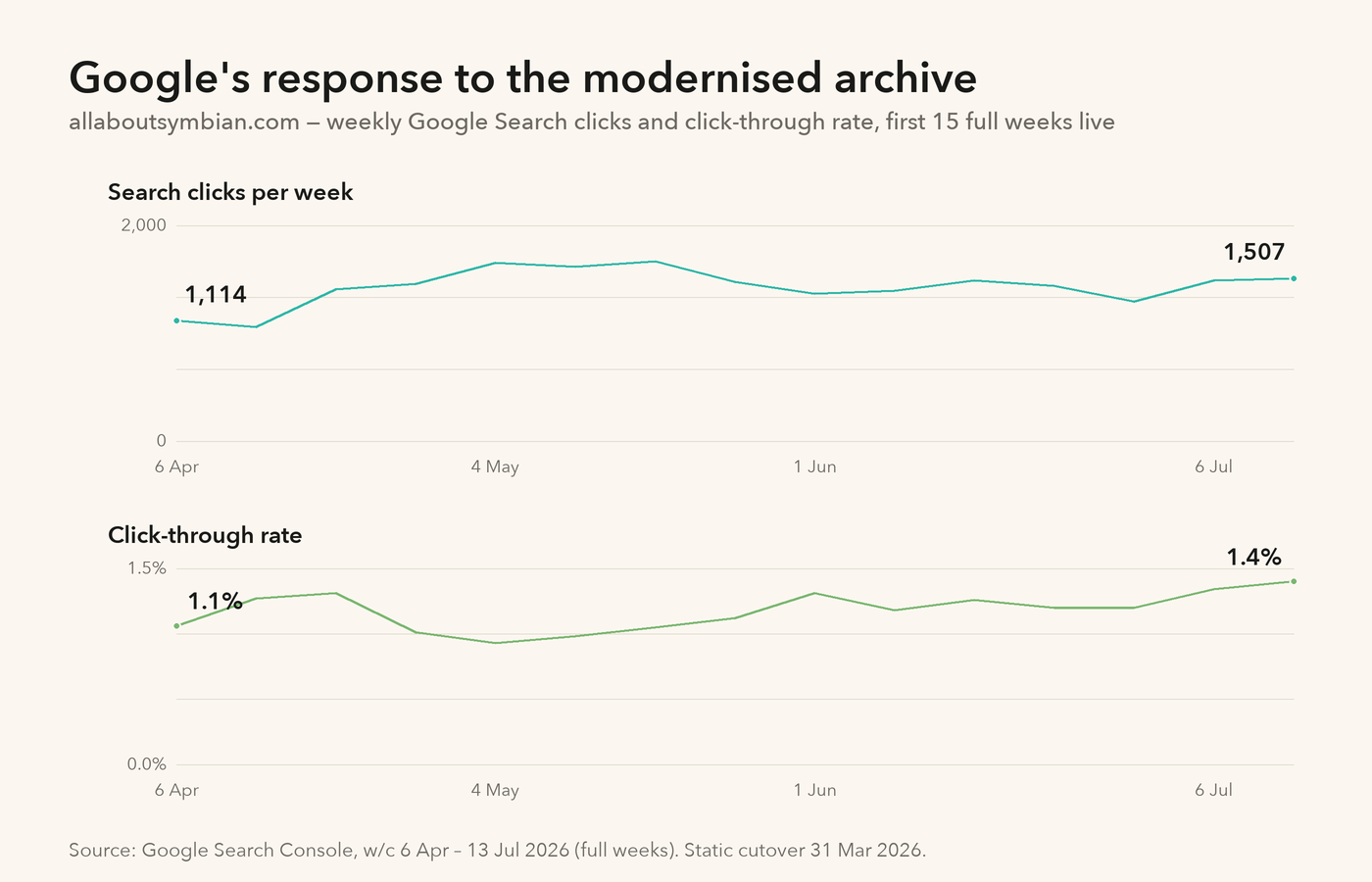
Three things stand out in the All About Symbian data:
- Clicks ratcheted up and held. From 1,114 in the first full week to a sustained ~1,430 average over the last six weeks — up 29%, with no new content to explain it.
- Click-through rate rose from 1.06% to 1.26%. When the pages appear in results, more people choose them. That's consistent with what richer snippets and faster pages are supposed to do — the listing itself got better, not just more frequent.
- The impressions curve tells a re-evaluation story. Google spiked impressions to a peak in early May — around 177,000 in a week, plausibly re-testing the re-crawled pages across many queries — then settled roughly a third lower. Clicks held through that settling. Google showed the archive less, but better.
Same treatment, three outcomes
The section above tells a simple, positive story, but here's the slightly messier reality. All three sites got identical treatment. They did not get identical results.
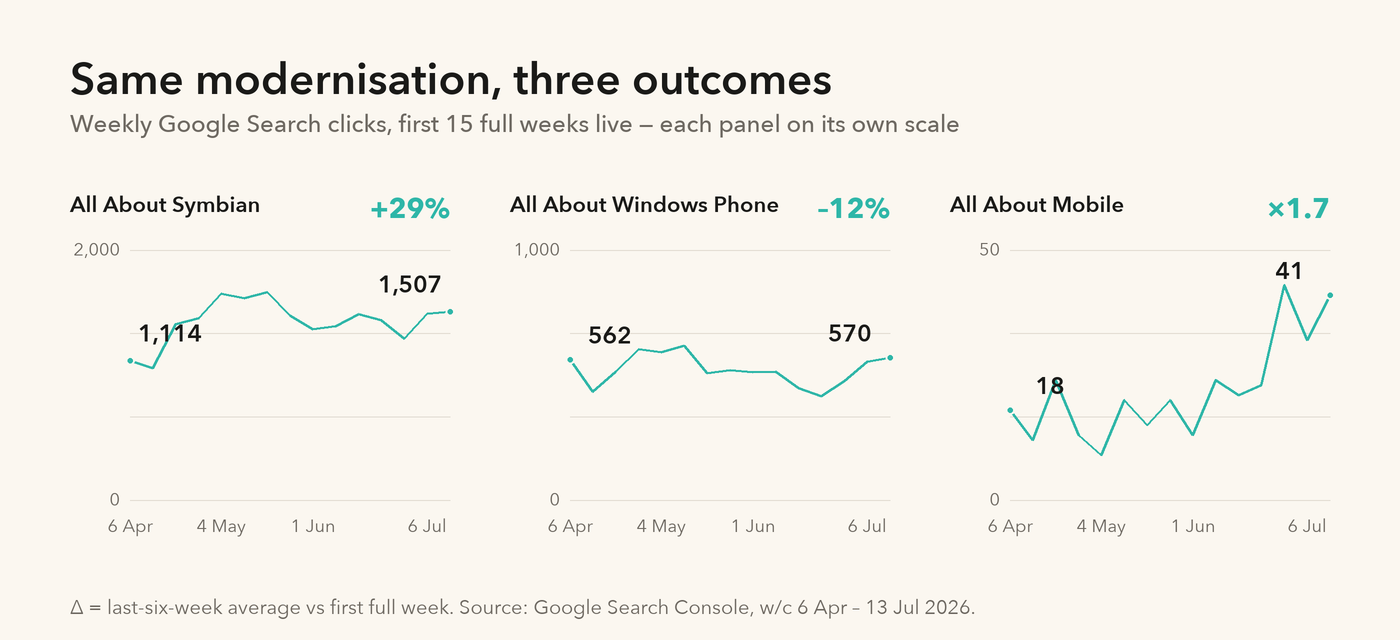
All About Mobile — the smallest site — grew the most, roughly 1.7× on both clicks and impressions, but I would take that with pinch of salt, given the low volume. All About Symbian gained steadily. All About Windows Phone drifted down 12%, though is now showing upward signs. Same schema scripts, same performance work, same infrastructure. The difference is presumably demand and competitive context per topic: technical quality changes how Google evaluates your pages, not how many people care about Windows Phone in 2026.
Why this matters
For a frozen archive, technical quality is the only lever there is — no new content, no outreach, nothing else to pull. What the data shows is that Google demonstrably re-evaluates: a site that will never publish again can still improve in search, because the ranking systems keep re-reading the signals you send. Twenty years of accumulated authority is an asset, but it pays out through a technical surface that either helps or hinders.
For living sites the implication is sharper. These signals — speed, structured data, crawl hygiene — are the floor under everything else you do. And the cost of getting them right has collapsed: this entire modernisation, 145,000 pages, was days of agentic work rather than a quarter of engineering. The excuse for a slow, schema-less, error-ridden site is gone.
The other quiet enabler is the measurement itself. The charts above come from programmatic Search Console access feeding a weekly analytics digest — the same instrumentation that flagged the trends in the first place. Modernise the site, but modernise the measurement with it.
New writing by email
Occasional pieces on product, technology and AI — and how they actually play out in practice.